


If you were asked to think about a physical phenomenon that’s responsible for any sort of force in the Universe, what answer would you give? Most people, when asked, respond with one of two answers. Most people will give gravity as their answer: the attractive force between all objects with mass or energy. Alternatively, they’ll list any other force that occurs between atoms on Earth, all of which are some manifestation of the electromagnetic force. Either:
- there’s an attractive force between two particles with mass-or-energy, as in gravitation,
- or there’s an attractive or repulsive force between systems of charged particles either at rest or in motion, as in electromagnetism.
But those are only two of the four fundamental forces (at least, we think there are only four) known to physicists today. The other two forces, however, are arguably at least as important for creating the collections of matter and energy that exist in the Universe: the nuclear forces. After all, the nuclear forces are required to determine the atomic number of every atom: the number of protons in an atom’s nucleus. That’s the property which determines the physical and chemical properties of all the normal matter on Earth, as well as everywhere else in the Universe. Without the strong nuclear force, the repulsive force between the positively charged protons in every nucleus heavier than hydrogen would destroy it instantly; that strong force is required to hold the core of every other species of atom together.
The very building blocks of matter would fall apart without the strong nuclear force. So how does it work? Let’s find out, and let’s do it without using the analogy of color.

The first thing you have to understand is that atomic nuclei — what we typically think of as a combination of protons and neutrons — are actually a lot more complex than just a collection of two types of particles. Protons and neutrons are distinct in many ways:
- protons are electrically positively charged, neutrons are electrically neutral,
- protons are stable when free and isolated, free neutrons are unstable in isolation, where they will decay with a half-life of about 10 minutes,
- you can have combinations of protons and neutrons bound together, and you can even temporarily bind two protons together, but you can’t bind two neutrons together at all,
- and protons have a very specific mass, while each neutron is about 0.14% heavier than each proton is.
Although it’s true that protons and neutrons, bound together in various combinations, make up all of the elements and isotopes found in nature, they don’t tell the full story of what makes up the normal matter in our Universe. That’s because it’s also true that neither protons nor neutrons are fundamental particles. Inside each proton are three quarks: two up quarks and one down quark, bound together through the physics of the strong nuclear force. Similarly, each neutron also has three quarks: two down quarks and one up quark, similarly bound through the strong force.
As you’ve already guessed, the strong force is fundamentally different from gravitation and electromagnetism in a number of ways. The first is this: whereas gravitational and electromagnetic forces both get stronger as two “charges” get closer together, the strong force actually drops to zero at extremely short distances.

If you halve the distance between two masses, the gravitational force quadruples or even more-than-quadruples, particularly if you’re in a strong gravitational field around a black hole or neutron star. If you halve the distance between two electric charges, the electrostatic force quadruples, with like charges repelling one another with four times the original force and opposite charges attracting one another similarly.
The strong force is similar to gravity in one sense: that it’s always attractive. However, in every other fashion, it’s tremendously different from both gravity and electromagnetism. For instance, if you were to halve the distance between two of the quarks inside a proton or neutron, the force not only doesn’t quadruple, but actually drops: becomes smaller than it was back when the distance was greater. In fact, if you went in the opposite direction and increased the distance between these particles, the (attractive) force actually increases in strength, and that increase gets very rapid beyond a specific amount.
This means that there’s going to be a particular separation distance between the quarks that’s ideal: where the repulsive electric forces and the attractive strong force balance out. This explains why the proton and neutron have particular sizes to them, where each one has a radius that’s a little smaller than a femtometer. The strong force isn’t “an attractive pit” like gravity is, but rather is like a Chinese finger trap: the force increases as you pull quarks apart, but goes to zero if you bring them close enough together.

So what makes the strong force work the way it does? Normally, physicists give the answer in one of two ways. Either they go into the intricate mathematics of group theory — specifically the special unitary group SU(3) — to derive the relationships between quarks and the force-carriers of the strong force, gluons, or they use the flawed, but useful, analogy of colors.
Fortunately, we don’t have to go to such complex lengths to understand the strong nuclear force. All we have to do is recognize the other fundamental difference between gravity, electromagnetism, and the strong nuclear force: the way “charges” work in these theories.
- In gravitation, there’s only one type of “charge” that exists: positive mass, and/or positive energy. (Remember, Einstein showed that they were equivalent via his famous equation, E = mc².) If you have either mass or energy (or both), you’ll attract every other bit of mass or energy in the Universe.
- In electromagnetism, there are two fundamentally distinct types of charges: positive and negative electric charges. Like charges repel, opposite charges attract, and charges in motion generate magnetic fields, which can attract or repel one another and change a moving charged particle’s direction.
- But in the case of the strong nuclear force, there are not one, not two, but three fundamental types of charge.
Although this requires a bit of a leap to understand, there’s a tool we can use to help us understand these new types of strong charges: an equilateral triangle.

Each “side” of the equilateral triangle, conveniently labeled with “1” on the bottom, “2” on the upper right, and “3” on the upper left, represents a different type of charge that exists under the strong force; every quark has one and only one of these charges (1, 2, or 3) assigned to it. Unlike gravity or electromagnetism, however, nature forbids us from having an isolated object that has a net charge under the strong force; only uncharged combinations are permitted.
In electromagnetism, the way we’d arrive at a neutral state is by putting two equal-and-opposite charges together: a positive charge is balanced by a negative charge, and vice versa. With three charges for the strong force, however, there’s a property you might not expect: the way you get something neutral is by creating a combination where there are an equal number of representatives of all three types of charge together, which is why protons, neutrons, and a whole host of similar particles known collectively as baryons contain three quarks apiece.
Each quark, therefore, doesn’t just have this new type of charge inherent to it, but each quark contributes its charge to the overall particle — like a proton or neutron — that contains it. And if you contribute a “1” and a “2” and a “3” together, they bring you back to zero: an overall neutral particle. We can show this, rather than by a triangle’s sides, by each quark leading you in its one particular direction, bringing you back to your starting point only if you wind up with a “neutral” combination.

So far, so good. “But wait,” you’re probably thinking, “what about antimatter?” We can consider that next: if quarks have three types of positive charges (1, 2, and 3) to them, then what about the antiquarks? While normal matter and antimatter are strongly suspected to both have the same types of gravitational charges (positive masses/energies only), all electric charges are reversed for normal matter and antimatter.
So how does it work for the strong force?
Sure enough: there are “anti-charges” too for each of the antiquarks: the negative equivalents of the “1” and “2” and “3” for normal quarks. You can still think of this as making up a triangle, only this time, “-1” points to the left instead of to the right, “-2” points down and to the right, rather than up and to the left, and “-3” points up and to the left, rather than down and to the right.
The anti-charges for the antiquarks are equal and opposite to the charges of the quarks they correspond to. Similarly, just as you could put three quarks together to make a proton or a neutron, you can put three antiquarks together to make an antiproton or an antineutron. In fact, all of the known particles called baryons are made of three quarks, and for every baryon, there’s an antibaryon counterpart: made of three antiquarks instead.

“So,” you might now think to ask, “does that mean that any neutral, uncolored combination is possible in nature?”
Although there are other quantum rules that still have to be obeyed, the short answer is “yes.”
A quark and an antiquark — regardless of whether it’s a “1”/“-1” or a “2”/“-2” or a “3”/“-3” combination — are allowed, corresponding to a type of composite particle known as a meson. Three quarks, a “1” and “2” and “3” together, are allowed (forming baryons), as are three antiquarks: “-1” and “-2” and “-3” all together (forming antibaryons).
But you can always scale these results up, to include far more complex combinations.
- You can have two quarks and two antiquarks bound together: a state known as a tetraquark.
- You can have either four quarks and one antiquark, or four antiquarks and one quark, all bound together: a pentaquark.
- You can even have six quarks or antiquarks bound together all in a single state, or a three quark-three antiquark combo: either one makes a hexaquark state.
As far as we can tell, every combination imaginable, so long as it doesn’t violate certain other quantum rules that may come into play, is permitted.

Because these charges are just like segments of a triangle that pull you in one direction or another, it’s pretty easy to see that there are many equivalencies at play. If you like, keeping our ideas of “1”, “2”, and “3” for colors and “-1”, “-2”, and “-3” for anticolors, we can invent some truly bizarre mathematics that doesn’t correspond to the normal rules of addition and subtraction, but rather allows us to understand what the equivalence is between different quark/antiquark combinations.
For example:
- 1 + 2 + 3 = -1 + 1 = -2 + 2 = -3 +3 = -1 + -2 + -3 = 0 (three quarks, a quark-antiquark combination, or three antiquarks all make a colorless state),
- 2 + 3 = -1, or 1 + 3 = -2, or 1 + 2 = -3 (two quarks of any two types can be substituted for one antiquark of the remaining type), or
- -1 + -2 = 3, or -2 + -3 = 1, or -1 + -3 = 2 (two antiquarks of any two types will act as one quark of the remaining type).
Under any theory of forces, whenever you have a charged particle, it has the potential to interact with any other charged particle of that same charge-type. In gravitation, that’s either because of the curvature of spacetime (according to Einstein) or due to the exchange of gravitons (in quantum gravity), which we fully anticipate. In electromagnetism, both like and opposite charges exchange photons. But in this new interaction, the strong interaction, the three different types of charges, plus the three different types of anti-charges, lead to the exchange of gluons.
Instead of one fundamental type of gluon, however, there are eight types: a fact that deserves its own full article.

What’s the short explanation for why there are eight gluons?
Every time a charged particle emits a gluon, it has to either stay the same charge or change its charge into one of the other two allowed types. Similarly, every time a charged particle absorbs a gluon, only that same set of interactions is allowed, and so it also must occur. But the only way this can occur is if every gluon carries with it a combination of a “charge” and an “anti-charge” with it. Six of the eight possibilities are straightforward. You can have a gluon that’s a combination of:
- “1” and “-2”,
- “1” and “-3”,
- “2” and “-1”,
- “2” and “-3”,
- “3” and “-1”, or
- “3” and “-2”.
But you can’t just pair “1” and “-1” together (or “2” with “-2”, or “3” with “-3”), because quantum mechanically, those combinations are identical: they’re indistinguishable from one another. Whenever you have indistinguishable quantum states, all of the allowable possibilities mix together. In fact, it gets even more complicated, because these combinations look very similar to the quark-antiquark combinations we briefly mentioned earlier: the mesons, which also are composed of particles that are charged and anti-charged under the strong force (the equivalent of a color-anticolor combination).
Because of the way particles mix together in quantum physics, the mixing possibilities between “1” and “-1”, “2” and “-2”, and “3” and “-3” wind up yielding two physical and one unphysical gluon out of the equation, for a total of eight.
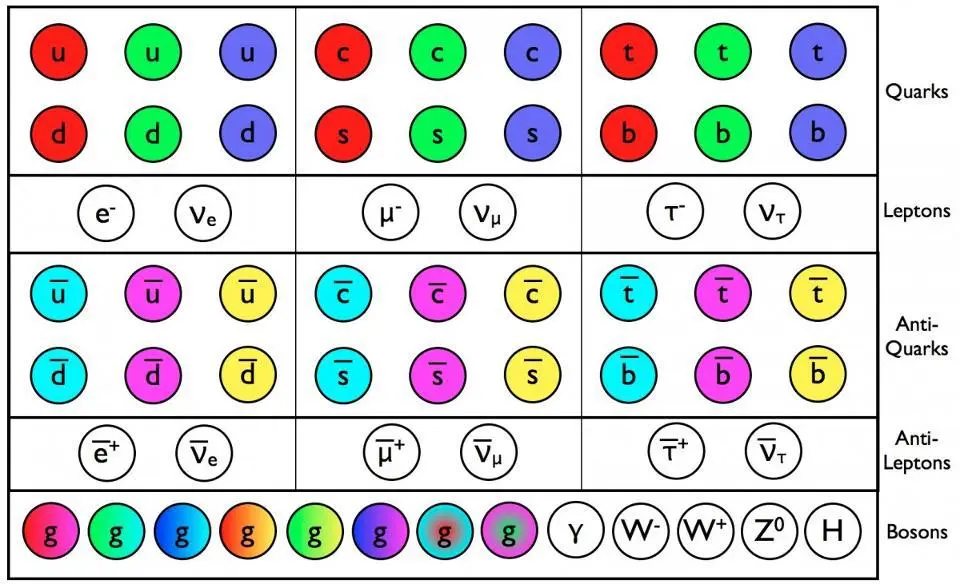
The reason people like the color analogy is because of how similarly color works to this. You can create a colorless combination by either mixing the three primary additive colors (red, green, and blue) together to make white or by mixing the three primary subtractive colors (cyan, magenta, and yellow) together to make black. Red and cyan are anticolors to one another, as are green and magenta, as are blue and yellow. Just as there are three primary additive and subtractive colors, there are three charges and anti-charges for the strong forces. But the analogy has many fundamental limitations, and it’s important to note that nothing is actually colored at all.
It’s also important to remember the following fact: there are two species of “chargeless” gluon and there are many ways to have a “chargeless” quark-antiquark combination with respect to the strong force (the mesons). As a result, individual protons and neutrons within an atomic nucleus will still wind up being attracted to one another, even though each one is uncharged, overall, under the strong force. Gluons (and mesons, for that matter) aren’t just exchanged between individual quarks within a proton or neutron, but can be exchanged between different protons or neutrons within a nucleus: what’s often called the residual strong force.
Remember, as long as you don’t violate any quantum rules, all exchanges are permitted, including exchanges of mesons: all of which are massive particles. Even though the force external to each proton or neutron goes away very quickly at large distances — the fate of all forces mediated by massive particles — this interaction is ultimately responsible for preventing all atomic nuclei from spontaneously splitting up back into free protons and neutrons.

It’s true that the Universe obeys a suite of rules that might seem arcane and complicated, where the best language for expressing those rules happens to be the language of mathematics. However, that doesn’t mean we have to understand the full complexity of that mathematical language in order to wrap our heads around what’s physically happening. When we come up with analogies that express the core concepts of what’s occurring while leaving the exact mathematics behind, we’re serving as translators: keeping the accuracy of the rules but making them accessible to far greater numbers of people. Every time we concoct a new way to present a scientific or mathematical phenomena, we gain a new tool in our arsenal for not only teaching it to others, but for better understanding it ourselves.
The strong interaction obeys all of the group theory rules associated with the special unitary group SU(3), and extensions of that line of thought have brought us to many creative places. However, unless you’re an advanced graduate student in either physics or mathematics, the language of group theory is probably not a language you’re fluent in. Similarly, the strong interactions can be described in terms of color, but the flaws in that analogy often leave long-lasting misconceptions, even among physicists. The “triangle” analogy presented here is more uncommon, but might help keep more of the mathematical intricacy of the theory while simultaneously eliminating numerous points of colorful confusion.
Regardless of how you interpret it, there’s an entirely new set of nuclear forces at play inside atomic nuclei, and the strong force is what holds every nucleus in the Universe together. The better we understand it, the better we understand the physics at the literal core of existence.
This article was first published in April of 2021. It was updated in April of 2026.

The Energy Transition


