20 years ago, the story of our Universe took an unexpected turn, when dark matter’s existence was confirmed empirically within the natural lab of the Universe: through the science of colliding galaxy clusters. Previously, we could only look at physical systems — individual galaxies, large clusters of galaxies, or the grand cosmic web on large-scales — and infer that something was missing. There were two plausible explanations: either the law of gravity was wrong and needed modifying on large cosmic scales, or there was a missing ingredient that was present and gravitated, but that defied direct detection.
That second explanation, known as dark matter, was initially favored because the addition of that one ingredient could explain all of the observed physical phenomena on a variety of scales, while modifying gravity required different modifications to align with different scales. However, the arrival of a direct comparative test changed the story dramatically. When two galaxy clusters collide, the normal matter inside — mostly in the form of gas — would interact, experience friction, heat up, and emit X-rays. However, if dark matter was present, it would pass right through unimpeded, with gravitational lensing revealing its contribution to the mass of these clusters.
It’s now 20 years since the first pair of colliding galaxy clusters, the Bullet Cluster, had both its X-rays and its gravitational lensing effects measured. It provided extraordinarily strong evidence for dark matter’s existence, and was hailed as the first direct empirical proof of dark matter. In the 20 years since, the dark matter explanation has been challenged many times, but each challenge has failed spectacularly. Here’s what everyone needs to know about it here in 2026.
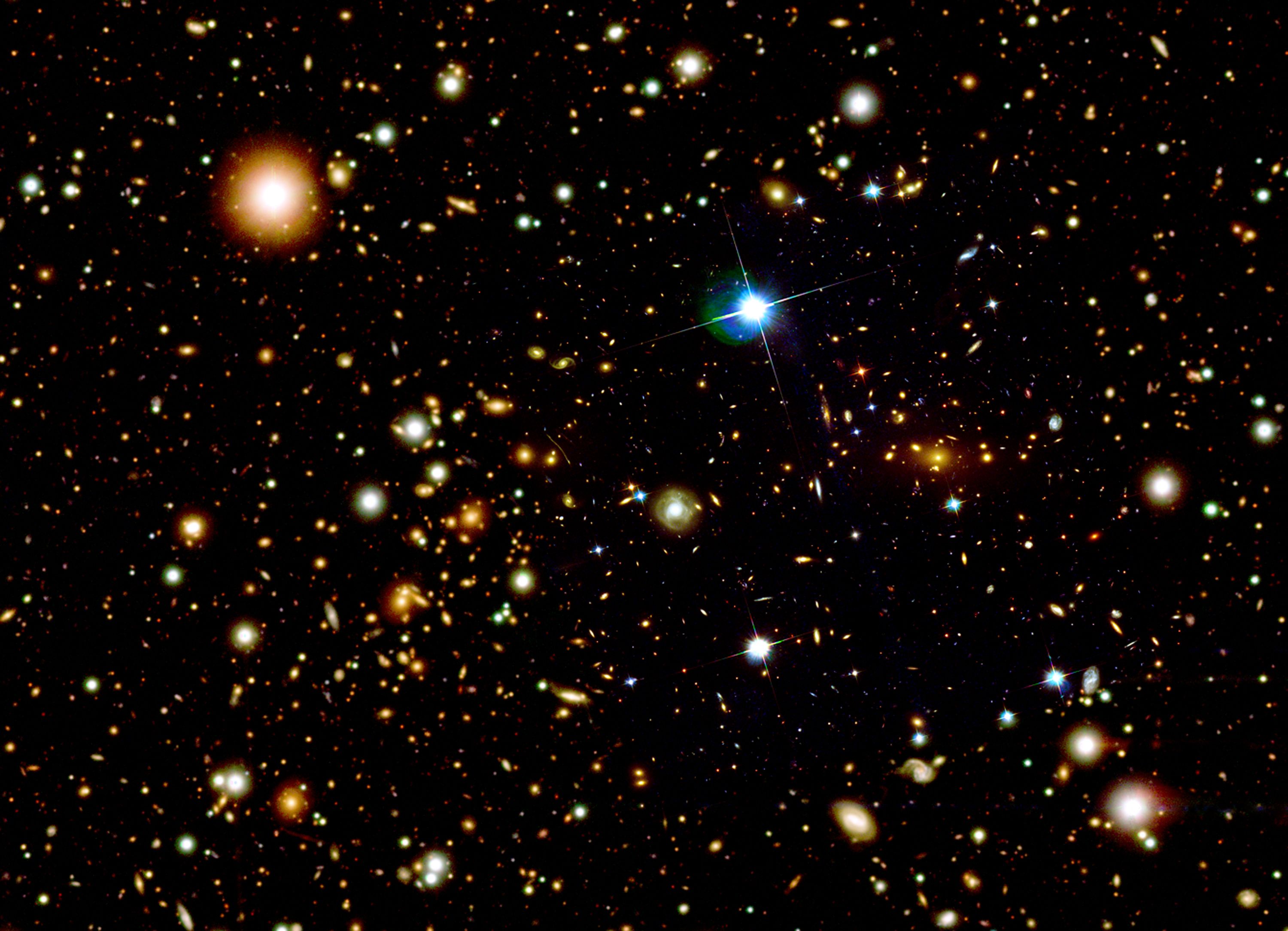
What you see, above, is an unfamiliar view of the Bullet Cluster: an optical image only, from the Hubble Space Telescope and the ground-based Magellan Telescope. What appears as a deep view of distant galaxies is a little richer upon close inspection. There appears to be a few strings of galaxies at the top and bottom, a large collection of galaxies toward the low-central left of the image, and a smaller, dense collection of galaxies toward the mid-right of the image. The two main collections of galaxies, to the left and right of the center, are extra interesting because they’re found at the same redshift as one another, indicating that, unlike most of the other galaxies in the image, they’re actually close together in three-dimensional space.
According to simulations of large-scale structure, this should occur in the Universe regularly: large mass objects like galaxy clusters will often form not too far from one another, and over billions of years, their mutual gravitational attraction will pull them in toward one another. At some point, the clusters will meet one another and collide. When they do, if there isn’t any dark matter, then the majority of the cluster mass — composed of gas and plasma in the space between the galaxies — will be co-located with the X-ray emissions that arise from the heating of that material from the collision. But if there is dark matter, then we should see a clear separation between the X-rays, which trace the normal matter only, and the inferred mass distribution from gravitational lensing, which ought to be dominated by dark matter.
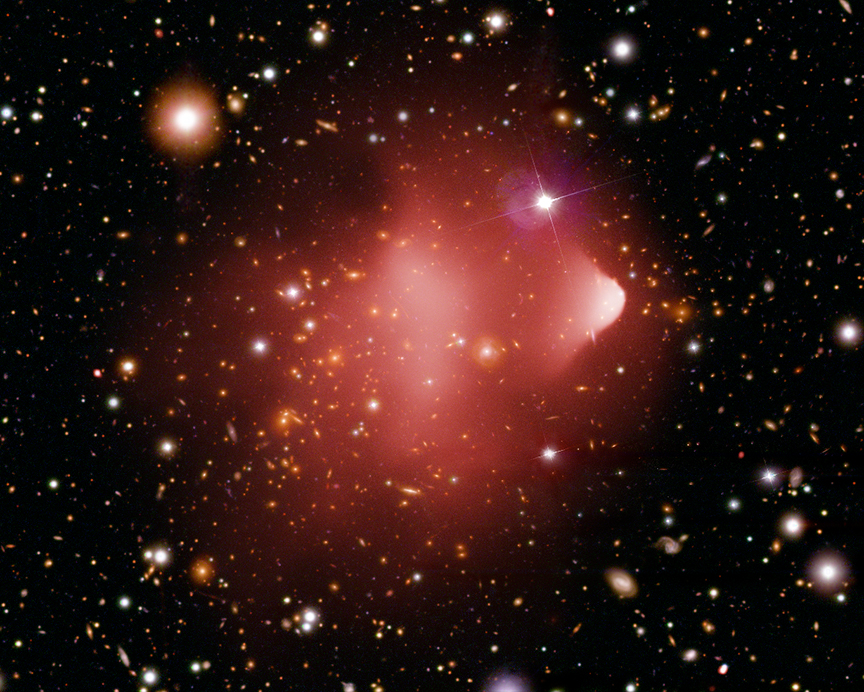
That’s why these joint observations are so important: they can tell these two key scenarios apart. When galaxy clusters collide, they’ll be moving quickly relative to one another due to their immense masses, at speeds of over a thousand and up to several thousand km/s. Even though galaxies themselves are large, the space between galaxies within a galaxy cluster is much greater. These three components will all behave differently than one another.
- Individual galaxies: these will largely pass through one another without any collisions of stars or disruptions of the galaxies themselves. It’s analogous to taking two guns, filling them with bird shot, and firing them at one another from 100 yards away. Sure, on a rare occasion, one pellet of bird shot from one gun will collide with a pellet from the other gun, but usually, the pellets will simply pass through one another unimpeded.
- Gas and plasma: at high speeds, these particles will collide with one another, exchange energy, slow down, and heat up. This leads to the X-rays being found in the space between the two galaxy clusters, trailing behind the galaxies themselves.
- Dark matter: if it exists, it should travel with the individual galaxies, passing through the collision unimpeded.
Because the gas and plasma is known to represent about seven times the total mass as the individual galaxies within a galaxy cluster, mapping out the effects of gravitational lensing is key. If the mass coincides with the X-ray gas, the gravitational lensing effects will be co-located with the X-rays. If the mass is instead locked up in the form of dark matter, the lensing effects will be co-located with the galaxies, and not with the X-rays. It’s a clear, straightforward, direct test.
Shown in blue, below, the gravitational lensing map was immediately decisive.
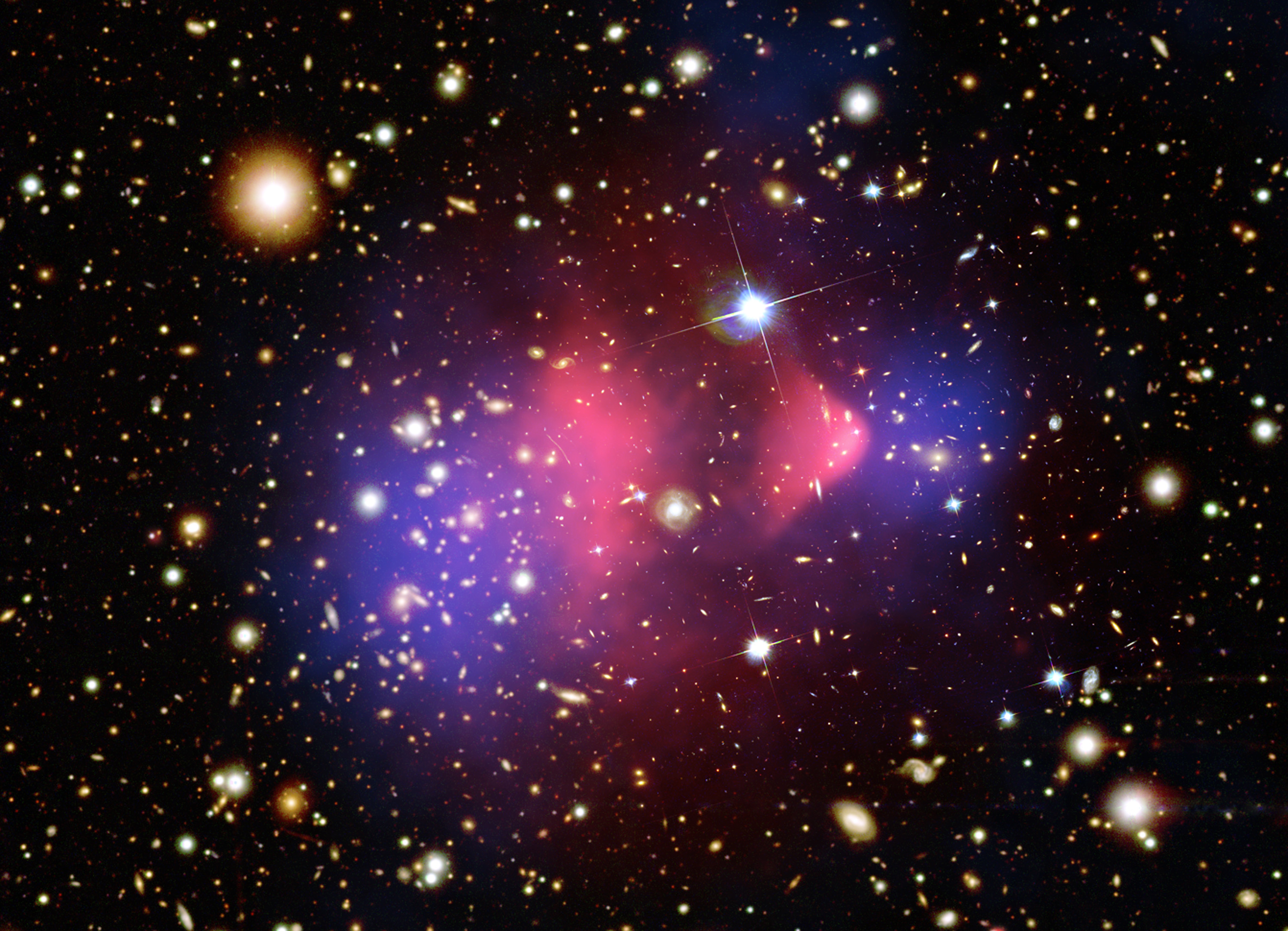
Your eyes can fill in what the data more robustly shows: that the normal matter, emitting X-rays (in pink), is trailing behind both the main two clusters of galaxies (at left and right) and also behind the gravitational lensing signals (in blue). The dark matter interpretation is validated by the data, while the modified gravity interpretation is inconsistent with what we see. For most astronomers and astrophysicists, this was the nail-in-the-coffin of alternative gravity theories, as this direct test from the natural laboratory of the Universe seemed to decide the matter with direct observational data.
Case closed.
Or was it? Those who favored the alternative to the mainstream — a modified gravity interpretation — came out with many objections and potential alternatives. One alternative, fascinatingly, posited that perhaps on very large cosmic scales, gravity was actually a non-local theory of gravity: meaning that the effects of gravity would show up where the mass wasn’t. The leading option for this was developed by John Moffat in the same year that the Bullet Cluster’s empirical proof was released. Moffat argued that his theory could explain this mismatch between the location of matter and the gravitational effects that were seen.
But if this explanation were correct, then it would be possible to test them by:
- finding galaxy clusters that are close to each other, but haven’t merged,
- and comparing their lensing maps with galaxy clusters that have already collided with each other.

If this modification to gravity were correct, then the two sets of systems — pre-collisional clusters and post-collisional clusters — would exhibit the same non-local effects: where the lensing effects were separated from the location of the normal matter. But this isn’t what we see at all. We see that clusters that are located nearby but haven’t collided, and I emphasize this here, display their gravitational effects to be co-located where the normal matter is: both the galaxies and the gas/plasma. There is no non-local gravitational effect for pre-collisional clusters, so if the law of gravity is the same everywhere, how can we see non-local effects for post-collisional clusters?
The answer is: we can’t, not if we want our theories to be self-consistent. That rules out the non-local option for a theory of gravity.
So what about other alternatives? Another possibility is that there are gravitational effects that arise from fields that are external to the gravitational system under consideration: what’s known as the external field effect. Although this has mostly been applied to explain the behavior of low-mass galaxies, some have attempted to use the concept as an argument that it could lead to the gravitational effects seen in the Bullet Cluster. However, it’s important to do what we call a “sanity check” in physics, and to make sure that the external field effect — sometimes invoked to explain what’s known as the baryonic Tully-Fisher relation — is indeed universal, and that it applies to all galaxies within its particular class. If not, then it cannot be a universal law at all.
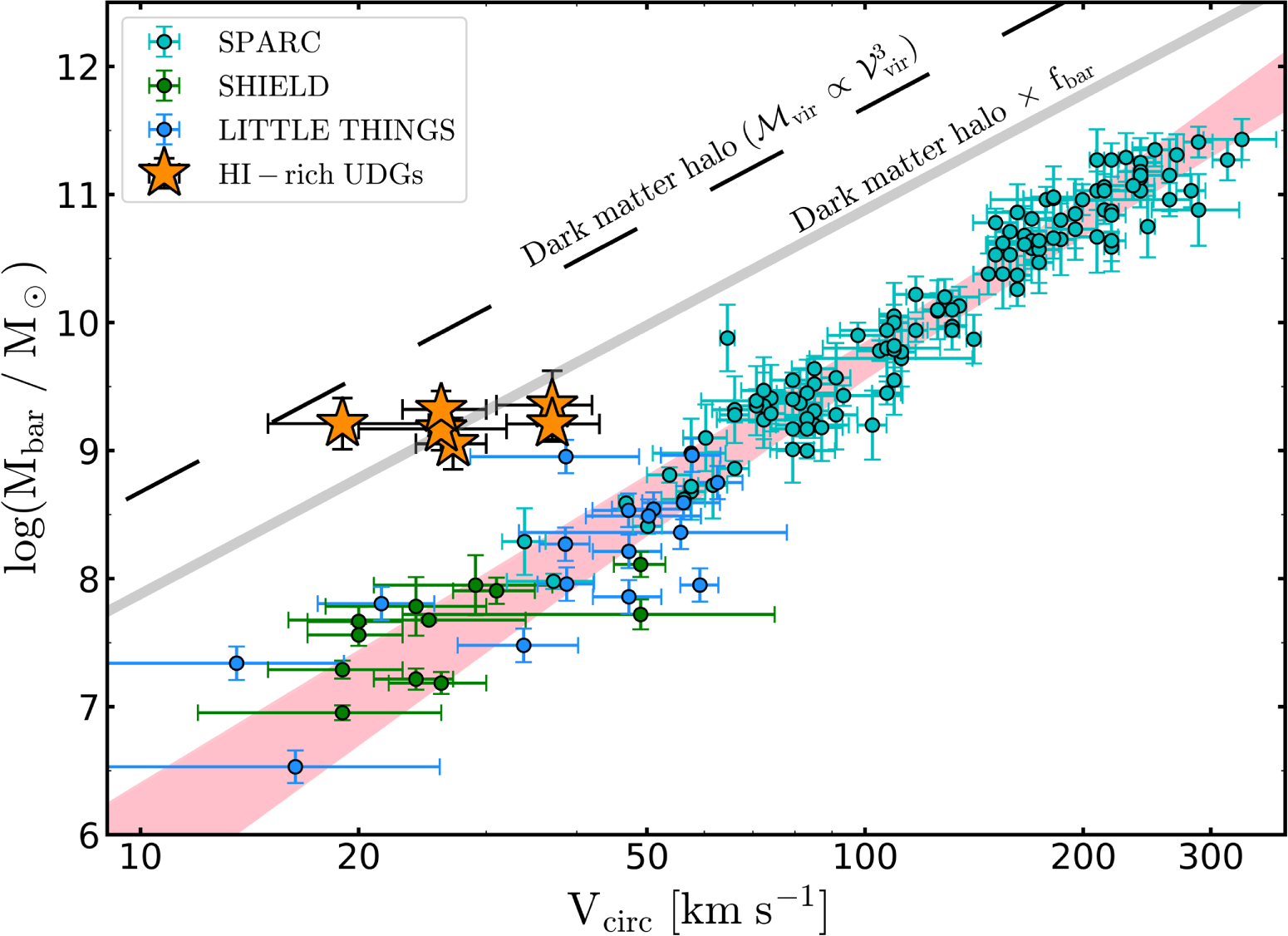
In the late 2010s, we discovered a new class of galaxy known as ultra-diffuse dwarf galaxies: galaxies where the internal motions of their stars appear to show evidence for the entire galaxy having little-to-no dark matter. These galaxies do not follow the relations predicted by either the external field effect or the baryonic Tully-Fisher relation, demonstrating that such an effect is not universal. Again, although its proponents would disagree, if the relation is not universal, there’s no reason to think it can be applied to a system like the Bullet Cluster to explain what’s observed.
There are always other possibilities to consider: a recent paper by Xavier Hernandez argues that only close-to-pointlike masses, like galaxies, would contribute to what we observe as a lensing signal, while the majority of the mass, if diffuse enough (such as was traced by X-ray data), would play pretty much no role at all. This grew out of an extension of MOND proposed by Moti Milgrom, MOND’s founder, in 2010: quasi-linear MOND, or QUMOND. While Hernandez demonstrated the difficulty in ruling out QUMOND as an explanation for the Bullet Cluster, it isn’t yet clear that QUMOND can explain the lensing signals from quiet, isolated galaxy clusters as well as Einstein’s general relativity with dark matter can; that research has yet to be conducted.

It’s also instructive to note that the Bullet Cluster was simply the first of its kind: the first system of massive, colliding galaxy clusters to be mapped out in terms of both its X-ray emission and also its gravitational lensing effects. However, many others exist. We don’t just have pre-collisional clusters and one post-collisional cluster, but a variety of galaxy clusters that have collided in the past, including:
- recently (within just a few hundred million years),
- less recently (within 1-to-3 billion years),
- or in ancient history (3+ billion years ago).
If we could see colliding galaxy clusters in different evolutionary stages, post-collision, this becomes even more difficult to explain with a single modification to the law of gravity. In a scenario where dark matter exists, this makes a lot of sense: the dark matter would move and gravitate, but wouldn’t interact with normal matter in any other way besides gravitation. We would see those gravitational effects migrate relative to the X-ray gas: moving just as galaxies move relative to that gas. At some moments, they’ll overlap; other times, they’ll be well-separated.
The geometric configuration of many of these colliding cluster systems have now been mapped out: optically, in X-rays, and through gravitational lensing, often in great detail.
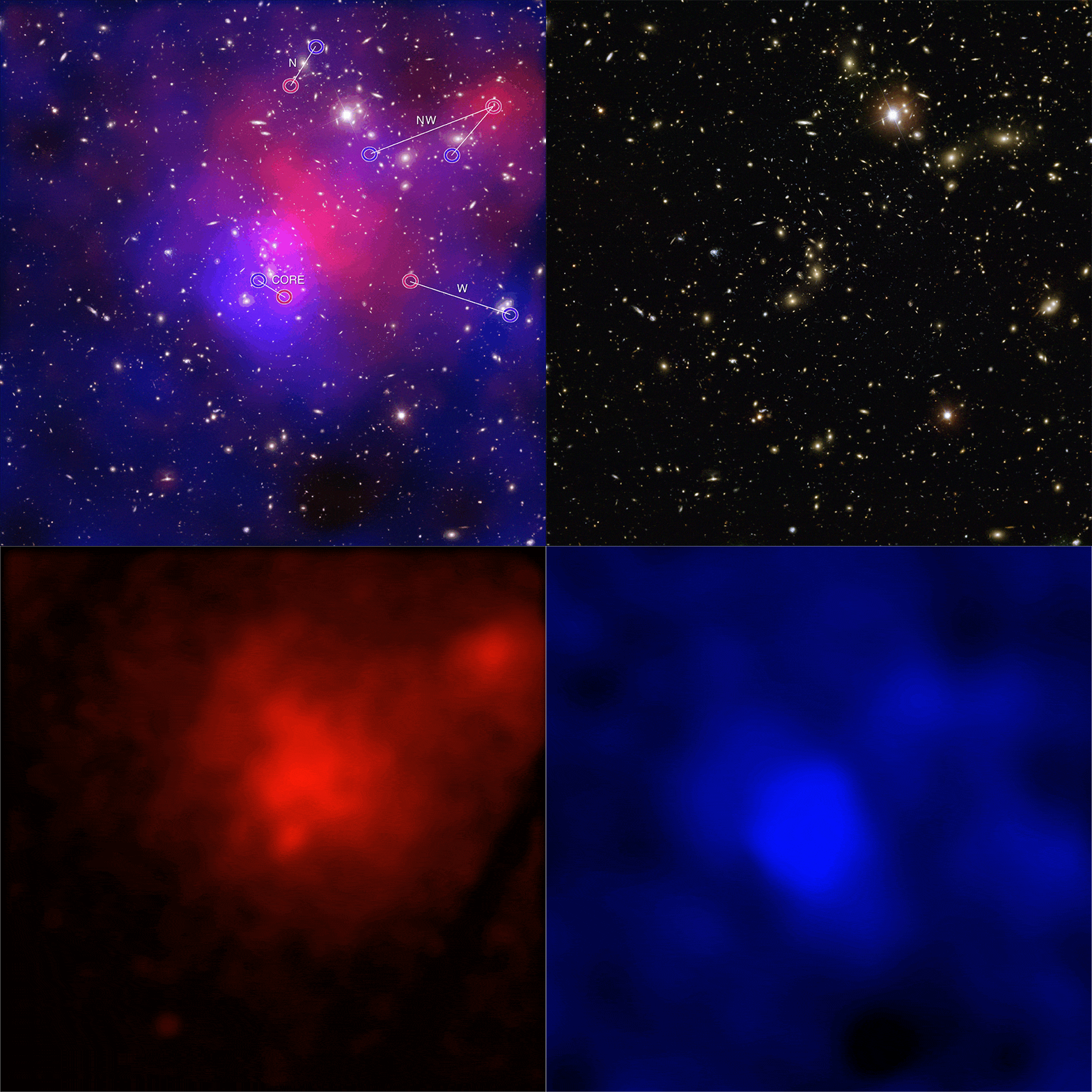
Other examples, in addition to Abell 2744, shown above, include:
- Abell 520,
- the Musket Ball Cluster,
- the (much lower mass) Bullet Group,
- the extremely hot Abell 2163,
- and the much more severely-separated MACS J0025.
However, the most common argument made by modified gravity enthusiasts against the dark matter interpretation of the Bullet Cluster (and other clusters) is this: that in order to produce the shocks seen in the Bullet Cluster’s X-ray data, the cluster had to be moving incredibly fast: somewhere around 5400 km/s. And that those speeds exceed what a dark matter-rich cosmology operating under Einstein’s general theory of relativity would predict, where cluster collision speeds more typically cap out around 4000 km/s or so.
This is a serious objection, and it was raised many times over the 2000s, 2010s, and even the early 2020s. Many other colliding clusters that show separations of X-ray emissions from the inferred mass also displayed evidence for high initial collision speeds, although the Bullet Cluster remains the fastest.
Is something flawed about the dark matter interpretation?
Could this be evidence that something else is truly at play?
It’s worth considering and taking seriously. However, we have to recognize that the way we found most of these colliding clusters was by mapping out both the X-ray and lensing data and looking for separations: where we’d see them because the collision occurred tangential to the line-of-sight. Then, in 2024, astronomers spotted something we’d never seen before: a colliding pair of clusters that occurred nearly along our line-of-sight to it.

The study, led by Emily Silich, focused on a system known as MACS J0018.5+1626. It also, like the Bullet Cluster, displays shocks in the X-ray data, which can be seen above. (Even if extracting the evidence of the shocks, visually, is difficult here.) However, unlike the Bullet Cluster, where the shocks are visually apparent but the velocity of the gas cannot be directly measured, the line-of-sight nature of this object allows us to make more direct inferences about the speed of the collision.
The conclusion is remarkable: these shocks, seen in MACS J0018.5, correspond to velocities that are much lower than the previously inferred velocity for the Bullet Cluster. Whereas the Bullet Cluster was initially claimed to require infall velocities (when the clusters were initially separated by about 3 Mpc, or 10 million light-years) of 5400 km/s, the direct data for MACS J0018.5 produces similar shocks at much lower infall velocities: between 1700 and 3000 km/s.
What accounts for this severe mismatch?
The answer is the unaccounted for influence of the circumcluster medium. Previous analysis had focused on the internal matter in the cluster, but ignored the possibility that:
- there was normal matter that surrounded each cluster,
- that circumcluster material collided first,
- pushed back on the normal matter inside the cluster,
- and created a cascade of interactions, heating up the internal matter and contributing to the formation of shocks.
This lowers the needed speed of the collision to produce the observed shocks precipitously, rendering the argument that “these clusters collided too quickly for our concordance cosmological model” a moot point.
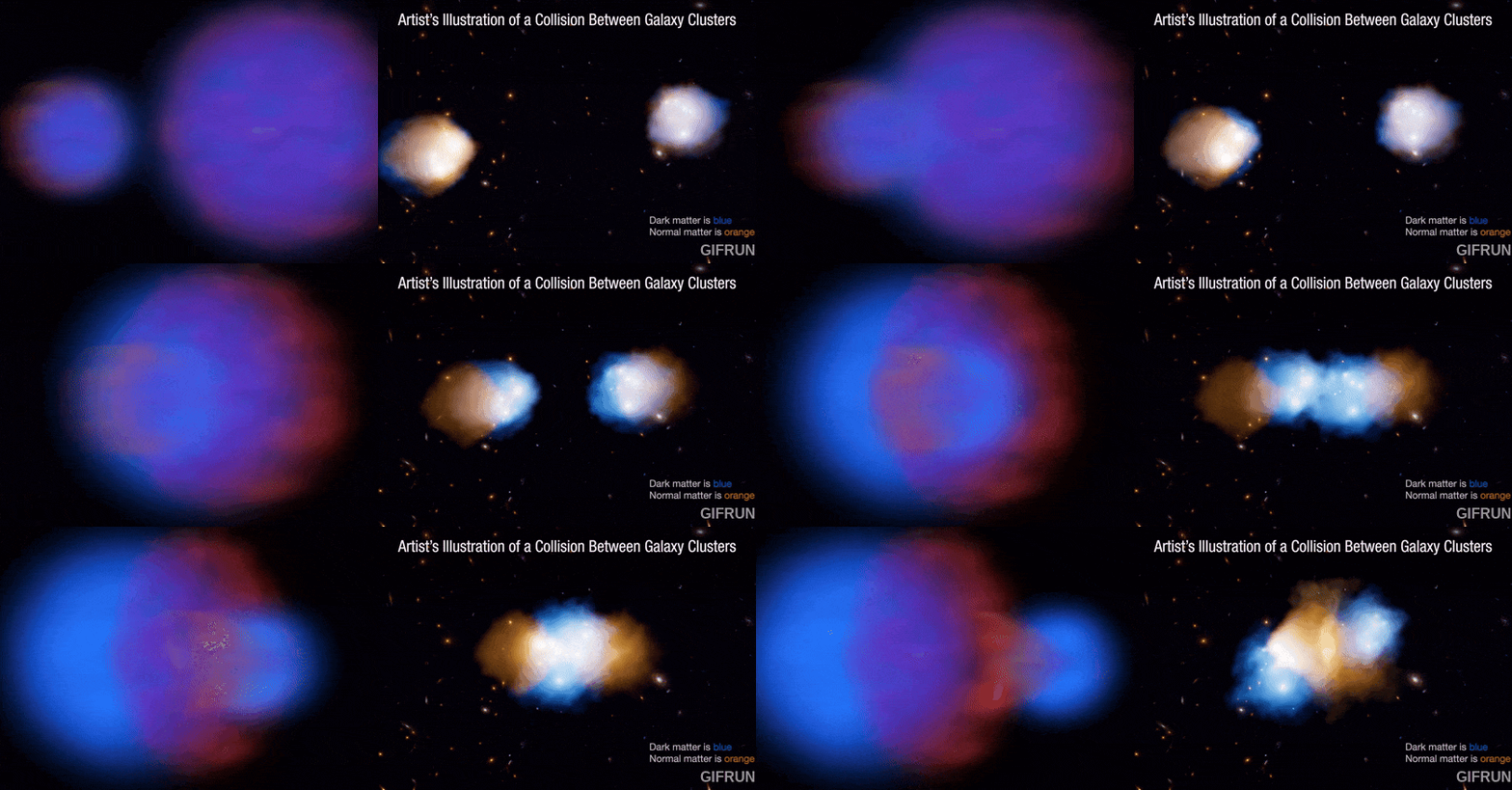
The velocities, now, are exactly in line with what one would expect from a dark matter-rich Universe governed by Einstein’s general relativity. The presence of the circumcluster medium, plus the measurements that support its existence and effects, arrived only two years ago, but they eliminate the problem of “too fast” of an initial velocity for these colliding galaxy clusters. The Bullet Cluster, in particular, is now thought to have needed relative initial speeds of only a little over 3000 km/s: nowhere near the 5400 km/s that were initially cited.
All of this makes the Bullet Cluster, and the full suite of colliding galaxy clusters, a remarkable testing ground for our theories of gravity. The dark matter hypothesis remains compelling, valid, and in agreement with the full suite of data, while the alternative — a modification of gravity — struggles mightily to explain even the very first such system ever discovered. Moreover, most of the assertions made by those seeking to undermine the dark matter hypothesis are now demonstrably incorrect, ruled out by the existing data.
It’s now been 20 years since the first empirical proof of dark matter was put forth by measuring the natural laboratory of the Universe itself: in the form of colliding galaxy clusters. The major objections to the dark matter interpretation have all been addressed and put to bed, and although new alternative proposals will no doubt continue to arise, they have yet to meet the challenges put forth by the full suite of cosmological data. To the best of our knowledge, dark matter explains what we see on galactic, galaxy cluster, colliding cluster, and the grandest of cosmic scales, while MOND-like alternatives simply cannot say the same. It might be fun to entertain contrarian interpretations and alternatives, but when it comes to drawing conclusions about the nature and composition of our shared reality, data from the Universe itself will always have the final say.

The Energy Transition