


When it comes to the distant galaxies in the Universe, one of the most profound discoveries in all of history is also one of the most puzzling: the fact that they’re almost all mutually receding from one another. It was only in 1923 that we firmly established that extragalactic objects — objects beyond our own Milky Way — even existed, with Hubble’s detailed measurements of Andromeda placing its distance far beyond the Milky Way itself. Just a few years later, from 1927-1929, enough evidence had accumulated for scientists to establish the redshift-distance relation, also known as Hubble’s Law: where a distant galaxy’s observed recession speed is proportional to its distance from us.
If you think about that in detail, however, something puzzling emerges. If you look to great enough distances, that observed recession speed can get very fast indeed. Potentially, those speeds could approach, reach, or even exceed the speed of light! Is that a problem for physics? That’s what Jon Covey wants to know, writing in to inquire:
“I’m trying to understand how galaxies like MoM-z14 could be moving so fast. The energy needed to accelerate that mass at the Big Bang had to be infinite or nearly so. Is something wrong with our understanding of physics?”
Let’s start first by explaining the problem itself, and then let’s go back to the original tests we learned how to perform in an effort to make sense of the situation.
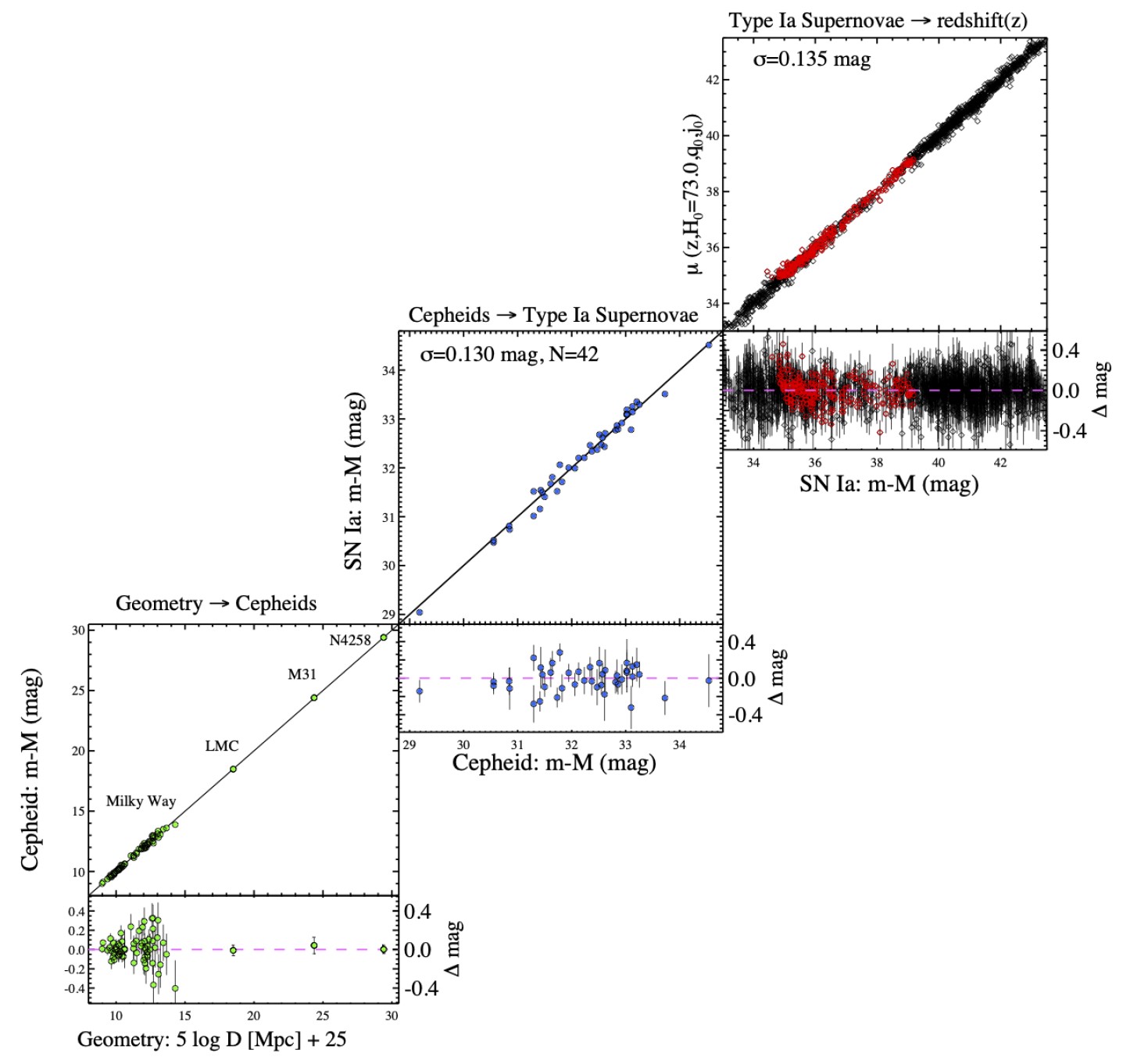
The problem is this: we know the Universe is expanding, and we’ve been able to measure the expansion rate very well in recent years. Even given the puzzle of the Hubble tension, where fundamentally different methods yield answers that disagree at the 9% level, everyone agrees that the modern expansion rate of the Universe is somewhere between 67 and 74 km/s/Mpc. (Where 1 Mpc = 1 megaparsec = 3.26 million light-years.) To be conservative, we can split the difference and say the expansion rate is approximately 70 km/s/Mpc. This means, for a galaxy at any given distance, we can predict what its recession velocity is going to be through that simple relation: v = Hr.
- For a galaxy 100 Mpc (326 million light-years) away, that’s a recession speed of 7000 km/s.
- For a galaxy 1000 Mpc (3.26 billion light-years) away, that’s a recession speed of 70,000 km/s.
- For a galaxy 4280 (14 billion light-years) Mpc away, that’s a recession speed of 300,000 km/s: the speed of light.
- And for a galaxy at the distance of MoM-z14, 10,400 Mpc (33.8 billion light-years) away, that’s a recession speed that equals 728,000 km/s, or more than double the speed of light.
Clearly, something’s wrong already. There’s no way that an object, any object, can move through space at speeds that exceed the speed of light. According to the rules of Einstein’s relativity, only massless objects can even reach the speed of light; objects with mass can only approach it from below, never reaching or exceeding it, no matter how much energy you put into it or how long you accelerate for.

You might think to yourself, “oh, of course, let’s just apply special relativity to this!” After all, the way we infer a galaxy’s recession speed is to look at the shift of its spectral lines toward longer wavelengths: a redshift. This lengthening effect happens all the time for all sorts of waves, not just light.
- If you have a regular series of waves in the water, if you move in the same direction as the waves, each one will take longer to pass and overtake you. If you move at the same speed as the waves, they’ll never overtake you at all.
- If you have a sound being emitted from a siren, if you move away from the emitting source, the sound waves will take longer to pass by you, lengthening the wavelength of the sound you hear and lowering the pitch. If you move at the same speed as the waves — the speed of sound — they’ll never catch up to you, and you’ll never hear them.
- But if you have light being emitted from a source, when you move away from the emitting source, the light will still always move relative to you at the speed of light, no matter how fast you go. Its wavelength will lengthen, but the waves will still overtake you: you can never move fast enough so that the light won’t catch you.
In other words, these severe redshifts that we’re seeing can’t be naively construed as moving at or faster than the speed of light; we’d have to switch to doing relativistic calculations. Can that help us?

If we apply the relativistic Doppler effect, instead of the classical recession velocities we applied earlier, we’d get somewhat different speeds for the same galaxies we considered earlier. Only this time, instead of distance, I’m going to display their redshift and what recession speed that translates into given that same expansion rate, today, of 70 km/s/Mpc.
- For a galaxy at redshift z = 0.0233, that’s a recession speed of 6900 km/s.
- For a galaxy at redshift z = 0.233, that’s a recession speed of 62,000 km/s.
- For a galaxy at redshift z = 1.414, that’s a recession speed of 212,000 km/s: 71% the speed of light.
- And for a galaxy at MoM-z14’s redshift, z = 14.44, that’s a recession speed of 297,300 km/s: 99.2% the speed of light.
This time, nothing is moving faster than the speed of light, as we used special relativity to transform the observed redshift into the corresponding difference between the velocities of the source and the observer.
It’s this line of thinking that leads to questions like the one we’re considering here: how did these objects acquire such great velocities? Where did they get the energy to be moving away so quickly? If this applies to all of the distant, high-redshift galaxies we observe, does this mean something’s wrong with physics for our understanding of the Universe?
I will note that the problem isn’t necessarily with viewing the recession as a Doppler shift; it can be done properly, although when most people try, it often leads to confusion. The problem is viewing it from a special relativistic perspective. To make sense of it, we have to think from a general relativity perspective, instead.
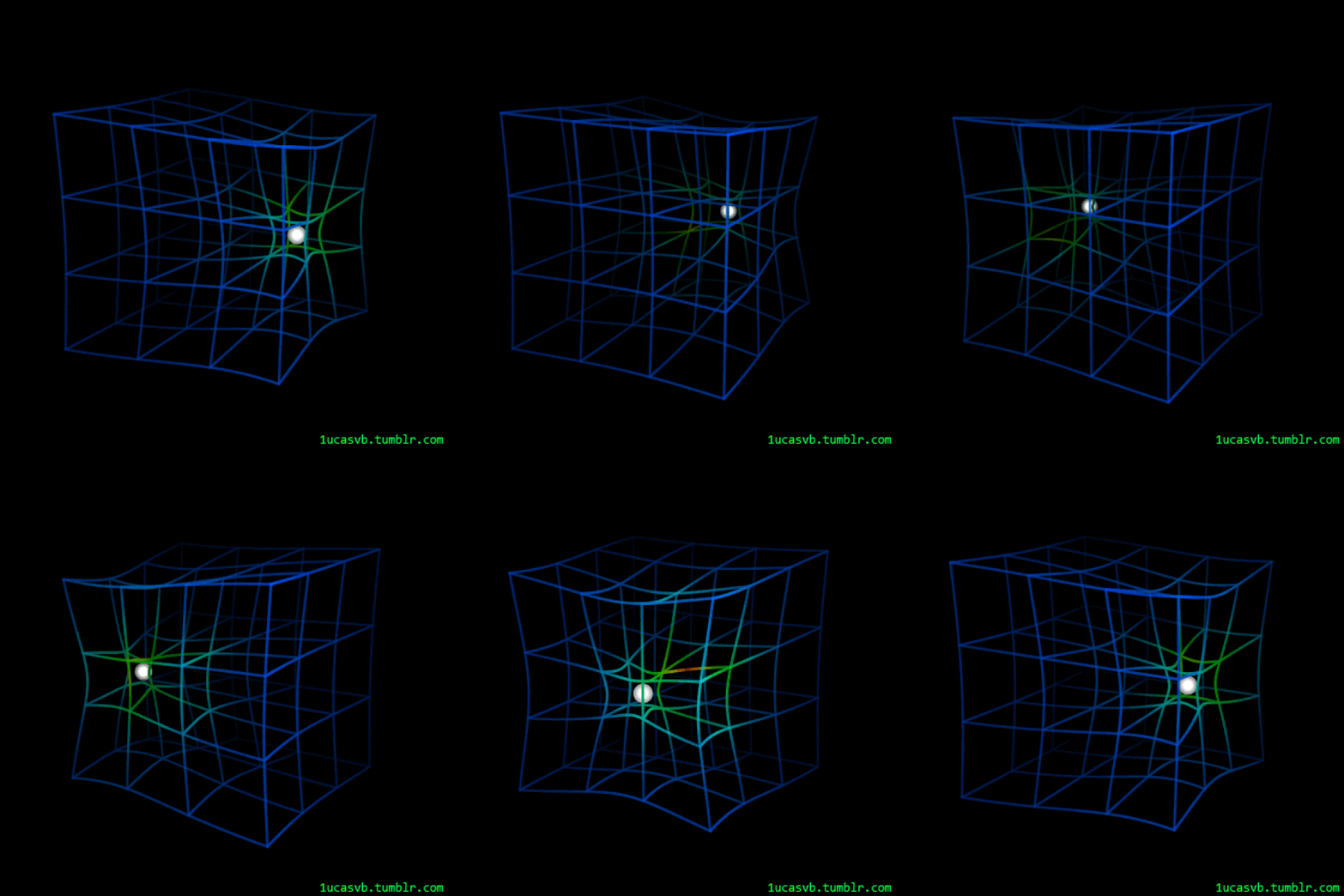
The biggest differences between special relativity and general relativity are as follows.
- In special relativity, spacetime is a fixed, static background. It is flat, with no curvature, and doesn’t evolve over time based on what’s in that spacetime.
- In general relativity, spacetime is a changing, dynamic background. It can be flat, positively curved, or negatively curved, and must evolve over time in a fashion that’s dependent on what the different forms of energy are within it, as well as how that energy is distributed.
If you only viewed our Universe from the perspective of special relativity, then it would be impossible for any object to be farther away than 27.6 billion light-years today. Remember, our Universe is 13.8 billion years old, as measured since the start of the hot Big Bang. Even if you began with an object that was 13.8 billion light-years away and moving away from us at 99% or more of the speed of light, then today, when that light arrives, that object would only be at a maximum distance of double that figure: 27.6 billion light-years.
But that is not how distances work in a universe governed by general relativity, and we have two different measurable things we can use to demonstrate that many distant galaxies — including MoM-z14 — are not only more distant than they would be in a universe governed by special relativity, but that are even farther away than that 27.6 billion light-year limit set by a special relativistic universe.

One test we can perform is to measure a distant galaxy’s angular diameter: how large, in terms of degrees, arcminutes, arcseconds, or fractions-of-an-arcsecond, does an observed object take up in the sky? You might think, if you took a galaxy and moved it twice as far away, it would take up just one-half of its original angular diameter. If you moved it ten times as distant, it’d be one-tenth the original size. And if you moved it a thousand times as far away as it was initially, you’d see it as just one-thousandth of its original angular size. This is just straightforward geometry, after all.
But that reasoning only applies to a special relativistic spacetime: one that doesn’t curve, expand, or otherwise evolve with time. In general relativity, however, an expanding universe leads you to a very different picture. As you move an object farther away from you, its angular diameter initially decreases as it would in a special relativistic spacetime: inversely proportional to its distance. However, at a certain point several billion light-years away, that decrease would slow and slow, eventually reaching a minimum angular size. Beyond that distance, the angular diameter grows again, meaning that if we can measure an object’s size at a given distance, we should be able to tell these two cases or interpretations apart.
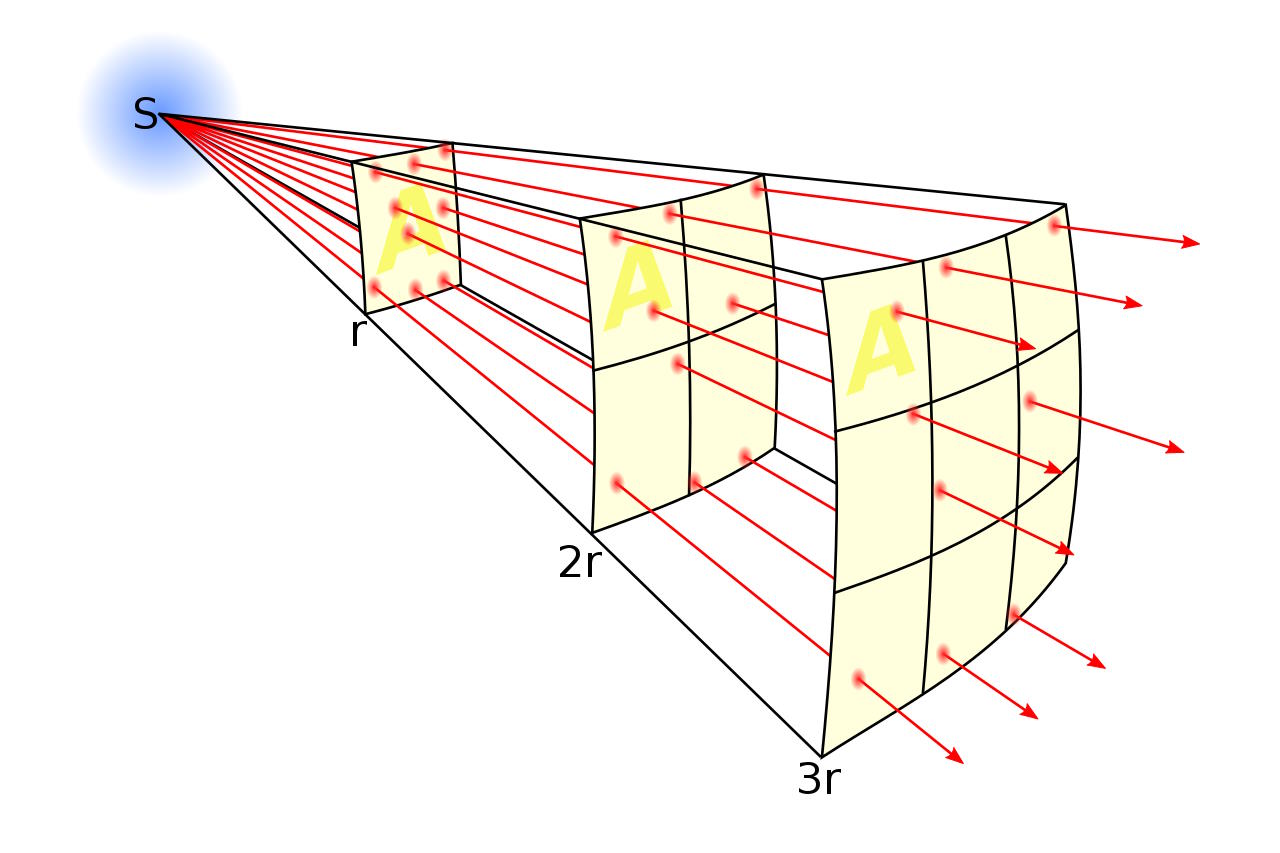
A second test we can conduct is to measure an object’s apparent brightness: how bright it appears to our eyes, telescopes, and instruments. In our everyday lives, we can see that brightness just falls off as shown above: as one over the distance squared, because light signals spread out in a sphere when they’re emitted from a source. An observer on Jupiter, five times as far away as the Earth is from the Sun, sees the Sun as just one-twenty-fifth as bright as a terrestrial observer would, while an observer on Neptune, thirty times as distant as on Earth, sees the Sun to be just one-nine-hundredth as bright.
But in our expanding Universe, the relationship is more complicated (dependent on additional factors that involve the object’s redshift) than it is in the naive, special relativistic picture. The farther away you bring an object, the fainter it appears, but at great distance, it appears brighter than the naive expectation. This is not just different than the naive expectation, but it’s also different from the angular diameter distance relationship.
This means that if you can:
- know an object’s intrinsic size and brightness,
- measure how bright that object appears (its apparent luminosity),
- measure how large that object appears (its apparent angular size),
- and compare their inferred distances,
you can actually determine how the Universe behaves, whether it’s expanding or not, and what its properties and composition are.
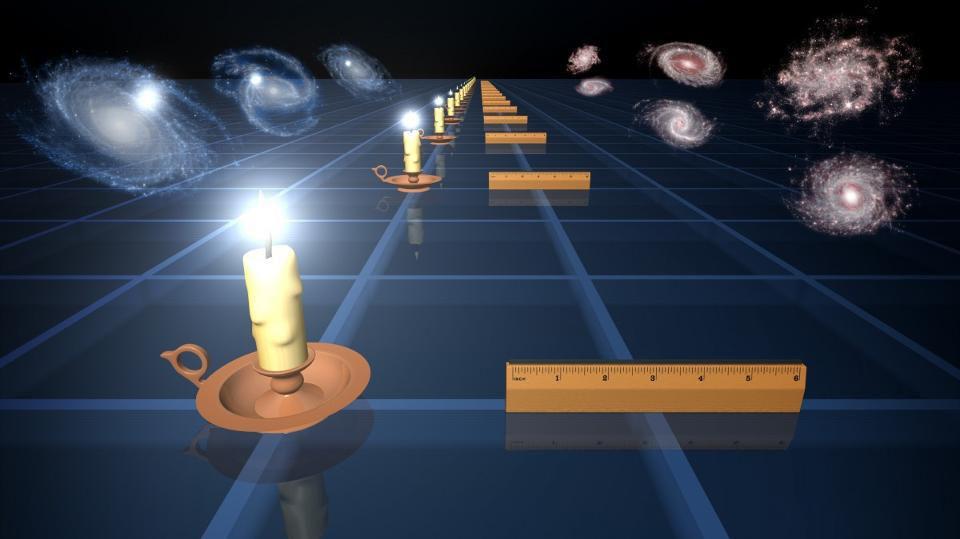
Although it’s a difficult task, we’ve managed to accomplish it in a variety of ways with a large number of different distance indicators, albeit, for many of them, with large uncertainties.
One thing the data is definitive about, however, is how inconsistent these tests are with a special relativistic universe: where objects just get smaller according to one-over-the-distance or where they get fainter as one-over-the-distance-squared. For objects in the relatively nearby Universe — within around one billion light-years of us — these differences are small, and measurement would need to be extremely precise to accurately report those differences: to just a few percent precision. It’s very difficult to get such accurate, precise estimates for individual objects, making such a determination difficult.
But at greater and greater distances, those differences become profound. At distances of around 10 billion light-years, the luminosity distance differs by more than a factor of two from the naive prediction. At those same distances, the angular diameter distance also differs by more than a factor of two from the naive prediction, but in the opposite direction. Even if we aren’t using the same objects for luminosity distance and angular diameter distance, we can still use these measurements to teach us about the type of Universe that we live in, and to see what sorts of rules it obeys.

The reason this is so important is because this is what we can measure directly: the properties of objects like “how bright do they appear” or “how large of a size do they take up?” We can’t measure the expanding Universe directly; we can only infer it.
What you’d want to do is have a large collection of objects — the same class of object but with many examples of it — at different distances and redshifts, but where some intrinsic property of that object is well-known. One of the best-known examples in astronomy of such a phenomenon is Type Ia supernovae. Now known to originate from the detonation of a white dwarf, typically upon collision with another white dwarf, there’s a well-known relationship between how intrinsically bright the supernova is and the time it takes that supernova to brighten, reach maximum brightness, and decline.
You can then infer the distance to that object based on how bright the object appears versus how intrinsically bright it is. When you also measure the object’s redshift and do this for hundreds or even thousands of objects, you can construct a redshift-distance diagram. This allows you to conclude what’s in your Universe, how it’s expanding, and whether it’s obeying the rules of special relativity, general relativity, or something else entirely.

We leverage this exact method, as well as several others just like it, that take advantage of various distance indicators, to measure the distance to various objects, to determine the expansion history of the Universe, and to demonstrate that our Universe isn’t consistent with a special relativistic perspective.
This last part is the most important. Once we recognize that we have to consider that:
- spacetime isn’t a fixed backdrop, but rather curves and evolves,
- that objects don’t just move through spacetime, but that spacetime itself expands,
- and that what we perceive as an object’s redshift is a combination of its motion through spacetime and the expansion of the Universe,
we can begin to make sense of both how far away objects are and how much of what we see as their redshift is and isn’t due to their motion. For MoM-z14, the current cosmic record-holder, we can determine that it’s approximately 33.8 billion light-years away from us right now: more than 6 billion light-years farther than the distance limit for a special relativistic universe. We can also say, for practically every object we can observe, that while they might have peculiar motions that cause them to move at hundreds or even thousands of km/s relative to the Hubble flow, the majority of their observed redshift, particularly at large distances, is all due to cosmic expansion, and not to their motion through space.

So no: there’s nothing wrong with physics. And yes, there was an incredible amount of energy present during the hot Big Bang, but very little of that energy goes into explaining why we see galaxies with the redshifts that they’re observed to have today. The Universe expands, but not because we had to put a lot of energy into it; rather, it’s because any universe that’s both governed by general relativity and also that’s uniformly filled with any type of matter and energy cannot remain static and stable: it must expand or contract.
Since our Universe is all of those things — it obeys general relativity and, on the largest scales, is uniformly filled with a mix of dark energy, dark matter, normal matter, neutrinos, and radiation — we should expect that it either expands or contracts, and data since the 1920s supports expansion. When we observe distant objects in the proper fashion and in enough detail, we can learn the relationship between redshift and distance, and we can see how the relationship differs dependent on whether we’re measuring an object’s apparent brightness (getting a luminosity distance) or its apparent size (getting an angular diameter distance).
It’s those direct measurements that teach us that no, these galaxies aren’t “speeding away from us” because something gave them a lot of kinetic energy early on, but rather that they have such large redshifts because the Universe is expanding. We often say that there’s no such thing as a free lunch, but in the expanding Universe, increasing separations — and the creation of new space — between mutually unbound objects isn’t just free, it’s also inevitable and mandatory.
Send in your Ask Ethan questions to startswithabang at gmail dot com!

The Energy Transition


