The galaxy Centaurus A is the closest example of an active galaxy to Earth, with its high-energy jets caused by electromagnetic acceleration around the central black hole. The extent of its jets are far smaller than the jets that Chandra has observed around Pictor A, which themselves are much smaller than the jets of Alcyoneus, which are still smaller than jets found in the newly discovered Porphyrion. This picture, alone, illustrates temperatures ranging from ~10 K to as high as several millions of K: hotter than the surfaces of the hottest stars.
Credit: X-ray: NASA/CXC/CfA/R.Kraft et al Radio: NSF/VLA/Univ. of Hertfordshire/M.Hardcastle et al. Optical: ESO/VLT/ISAAC/M.Rejkuba et al.
Jet-like features can be seen being generated around a wide variety of objects in the Universe: protoplanetary systems, Herbig-Haro objects, and black holes, including at the centers of giant galaxies and quasars.
The largest, longest, most powerful jets are generated by black holes, but it isn’t the black hole itself that launches or powers them, but rather the material around them.
Black holes can only gravitate; electromagnetic effects are responsible for making these jets. Thanks to observations of black holes both near and far, we’re finally figuring out what’s happening.
An astrophysics column on big questions and our universe.
Across the recesses of space, collimated jets frequently emerge.
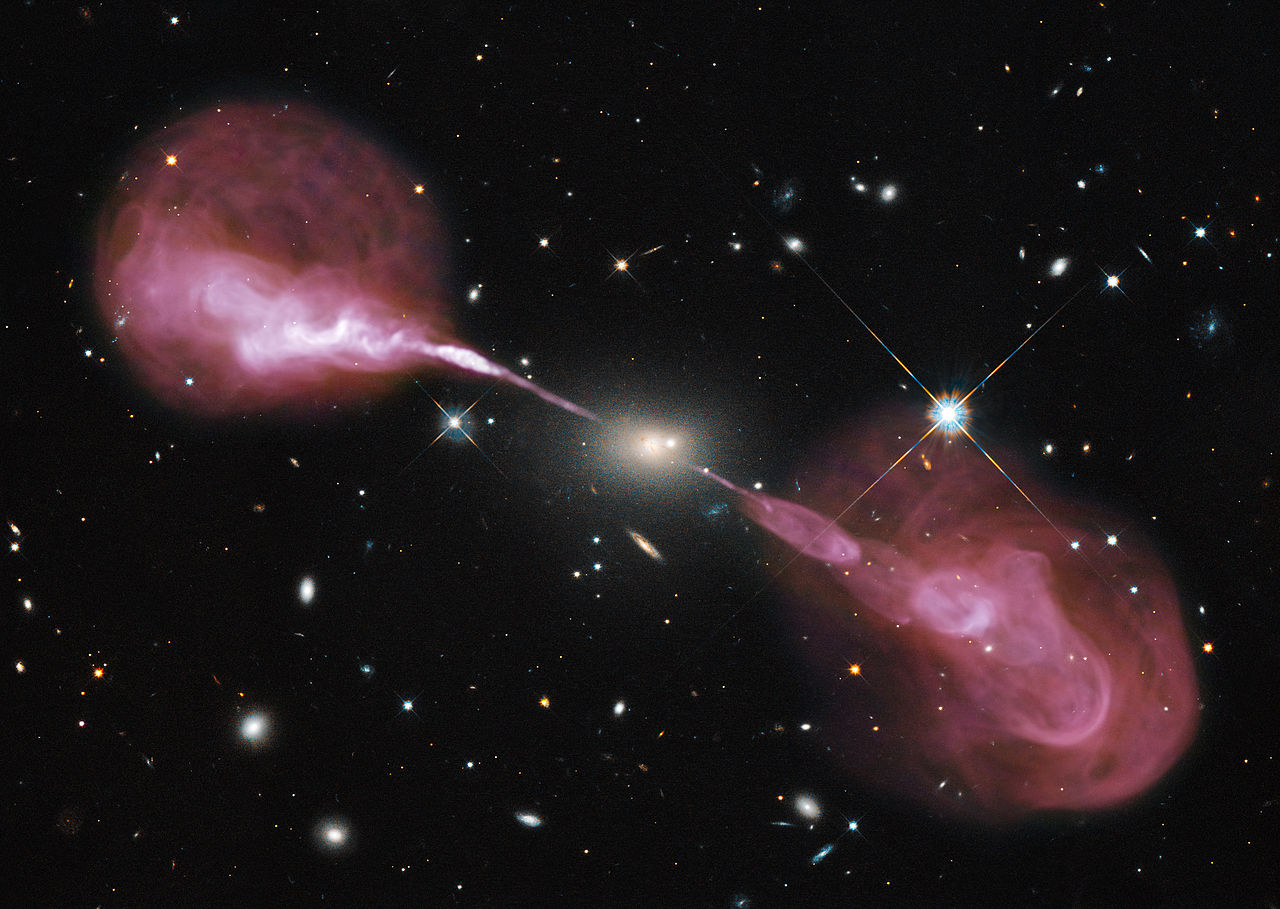
While distant host galaxies for quasars and active galactic nuclei can often be imaged in visible/infrared light, the jets themselves and the surrounding emission is best viewed in both the X-ray and the radio, as illustrated here for the galaxy Hercules A. It takes a black hole to power an engine such as this, but that doesn’t necessarily mean that this is matter/radiation escaping from inside the event horizon.
Credit: NASA, ESA, S. Baum and C. O’Dea (RIT), R. Perley and W. Cotton (NRAO/AUI/NSF), and the Hubble Heritage Team (STScI/AURA)
This tiny sliver of the GOODS-N deep field, imaged with many observatories including Hubble, Spitzer, Chandra, XMM-Newton, Herschel, the VLT, and more, contains a seemingly unremarkable red dot. That object, a quasar-galaxy hybrid from just 730 million years after the Big Bang, showcases how bright and powerful quasars can be. Many of the “little red dots” seen by JWST and other observatories are brightness-enhanced by the activity of the central black hole, with some jets pointing directly along our line-of-sight.
Credit: NASA, ESA, G. Illingworth (UCSC), P. Oesch (UCSC, Yale), R. Bouwens (LEI), I. Labbe (LEI), Cosmic Dawn Center/Niels Bohr Institute/University of Copenhagen, Denmark
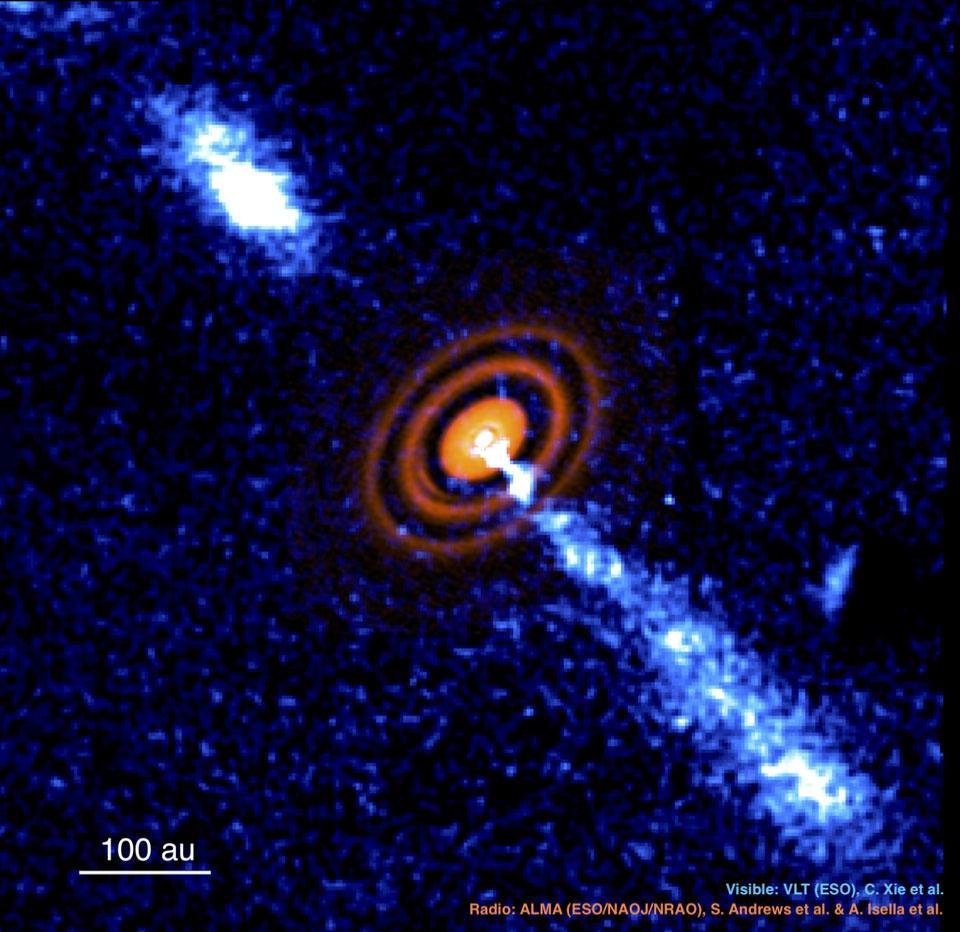
A composite radio/visible image of the protoplanetary disk and jet around HD 163296. The protoplanetary disk and features are revealed by ALMA in the radio, while the blue optical features are revealed by the MUSE instrument aboard the ESO’s Very Large Telescope. The gaps between the rings are likely locations of newly forming planets.
Credits: Visible: VLT/MUSE (ESO); Radio: ALMA (ESO/NAOJ/NRAO)
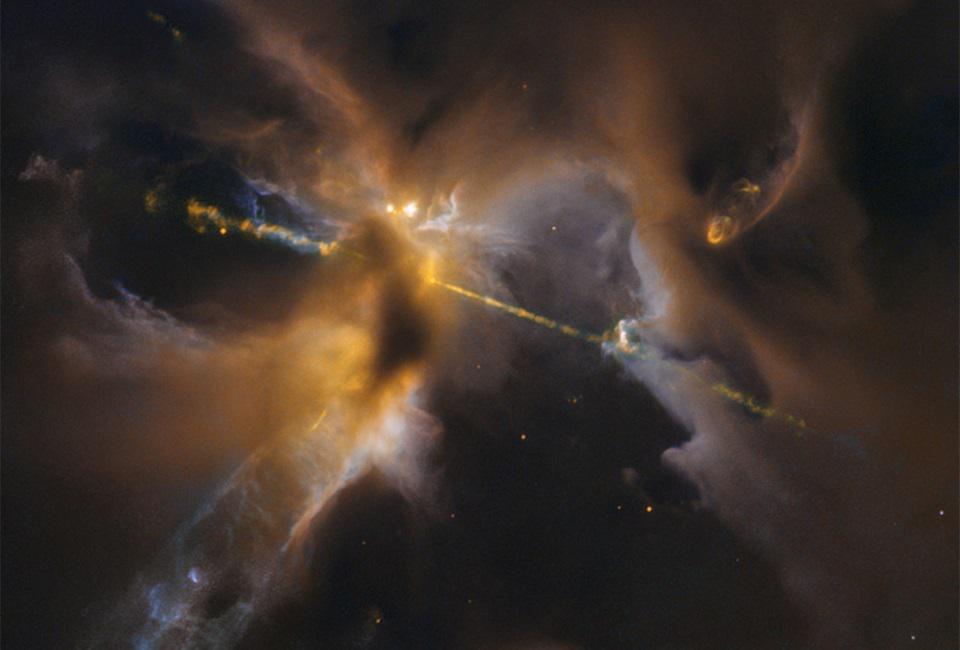
Ultra-hot, young stars can sometimes form jets, like this Herbig-Haro object in the Orion Nebula, just 1,500 light years away from our position in the galaxy. The radiation and winds from young, massive stars can impart enormous kicks to the surrounding matter, where we find organic molecules as well. These hot regions of space emit much greater amounts of energy than our Sun does, heating up objects in their vicinity to greater temperatures than the Sun can.
Credit: NASA, ESA, Hubble Heritage (STScI/AURA)/Hubble-Europe Collaboration; Acknowledgment: D. Padgett (NASA’s GSFC), T. Megeath (U. Toledo), B. Reipurth (U. Hawaii)
Within the dusty nebular complex of Digel Cloud 2S, as revealed coarsely by Subaru but in finer detail by JWST, many protostars, which often include jet-like features, can be seen. Some objects look very similar to background galaxies within the cluster, but they are just as likely to be protostars wrapped in a dusty cocoon.
Credit: N. Izumi et al., Astronomical Journal, 2024; Animation: E. Siegel
However, the objects themselves lack strong electric and/or magnetic fields: required to accelerate jets.
This composite JWST image of the object Herbig-Haro 30 in the Taurus Molecular Cloud shows many features common to young, massive stars: a dusty disk (seen edge-on here), reflective dust grains above and below the disk, bipolar jets running perpendicular to the central disk, and conical outflows dovetailing into tail-like ejecta. Inside, planets are suspected to be forming around the central young star, which has only recently transitioned from the protostellar phase into the fusion-driven main sequence phase of its life.
Credit: ESA/Webb, NASA & CSA, Tazaki et al.; Processing: E. Siegel
This infographic shows the anatomy and lifecycle of an active galaxy, where two bipolar jets are emitted from accelerated matter that develops within an accretion disk surrounding a supermassive black hole.
Interacting material, like normal matter, forms accretion disks surrounding massive objects.
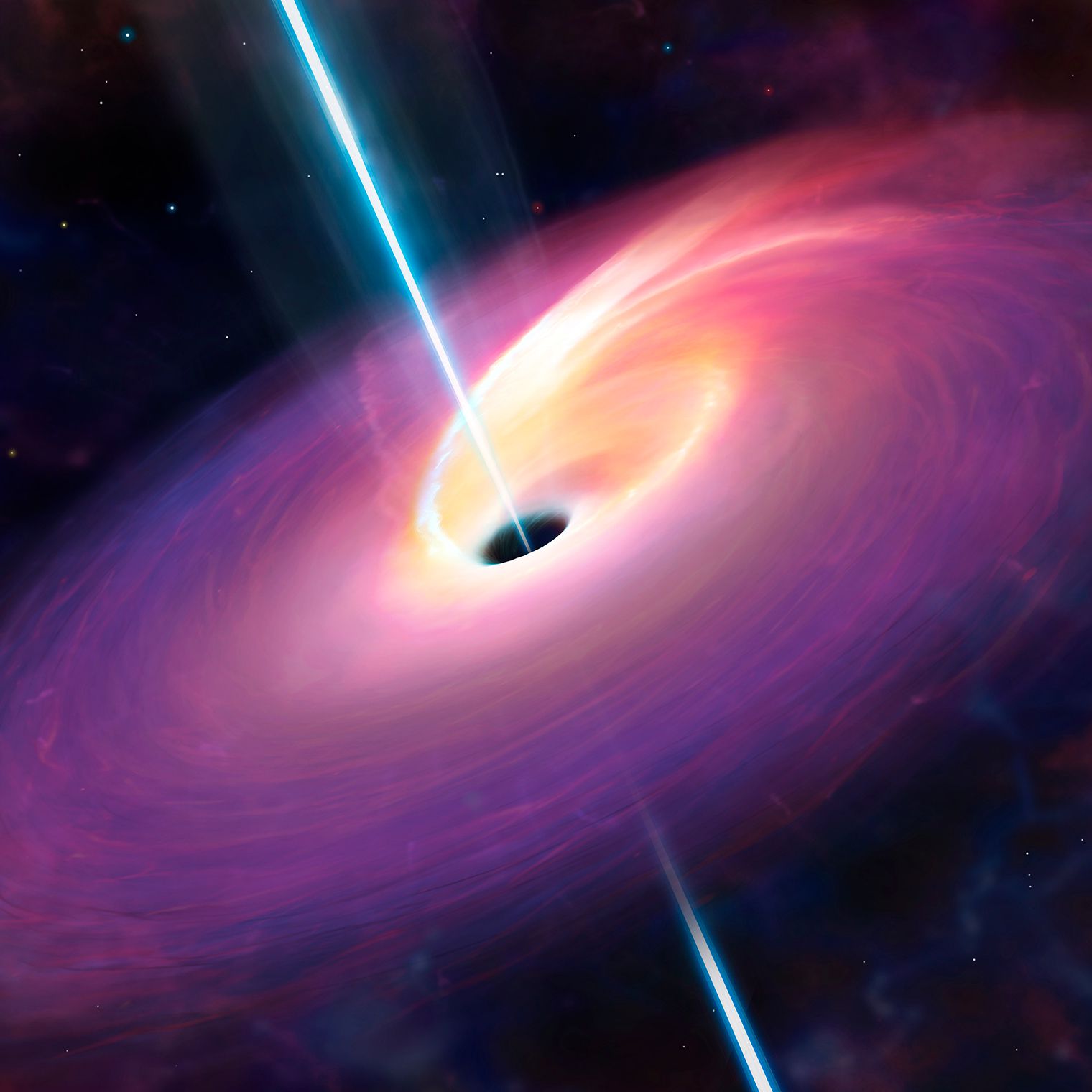
An illustration of an active black hole, one that accretes matter and accelerates a portion of it outward in two perpendicular jets. The normal matter undergoing an acceleration like this describes how quasars and active galaxies work extremely well. Flows of matter inside the accretion disk can lead to flares in a black hole’s emissions. All known, well-measured black holes have enormous rotation rates, and the laws of physics, particularly the conservation of angular momentum, all but ensure that this is mandatory.
As orbiting particles collide, they heat up, becoming ionized as they move rapidly.
Messier 87, best known as the supermassive galaxy whose black hole was first imaged by the Event Horizon Telescope, has its relativistic jets and the shockwaves created by their material imaged in the infrared by Spitzer, amidst the mass of shining stars (in blue). Messier 87 is the most massive (and second-brightest) galaxy within the entire Virgo cluster of galaxies, and it is the central black hole that generates these relativistic jets.
These fast-moving charged particles create powerful electric and magnetic fields, which can accelerate material.
This zoom-illustration shows the full scale of the galaxy Messier 87 complete with its relativistic jet in optical light (main), a very-long baseline interferometry view of its central region with a ring-like accretion feature and launched jets (inset), and the polarized light view of the event horizon itself (second inset). From the inside out, it’s the most accurate view ever obtained of any black hole ever.
Credits: NASA, ESA and the Hubble Heritage Team (STScI/AURA); Acknowledgment: P. Cote (Herzberg Institute of Astrophysics) and E. Baltz (Stanford University); R.-S. Lu (SHAO), E. Ros (MPIfR), S. Dagnello (NRAO/AUI/NSF); Event Horizon Telescope collaboration
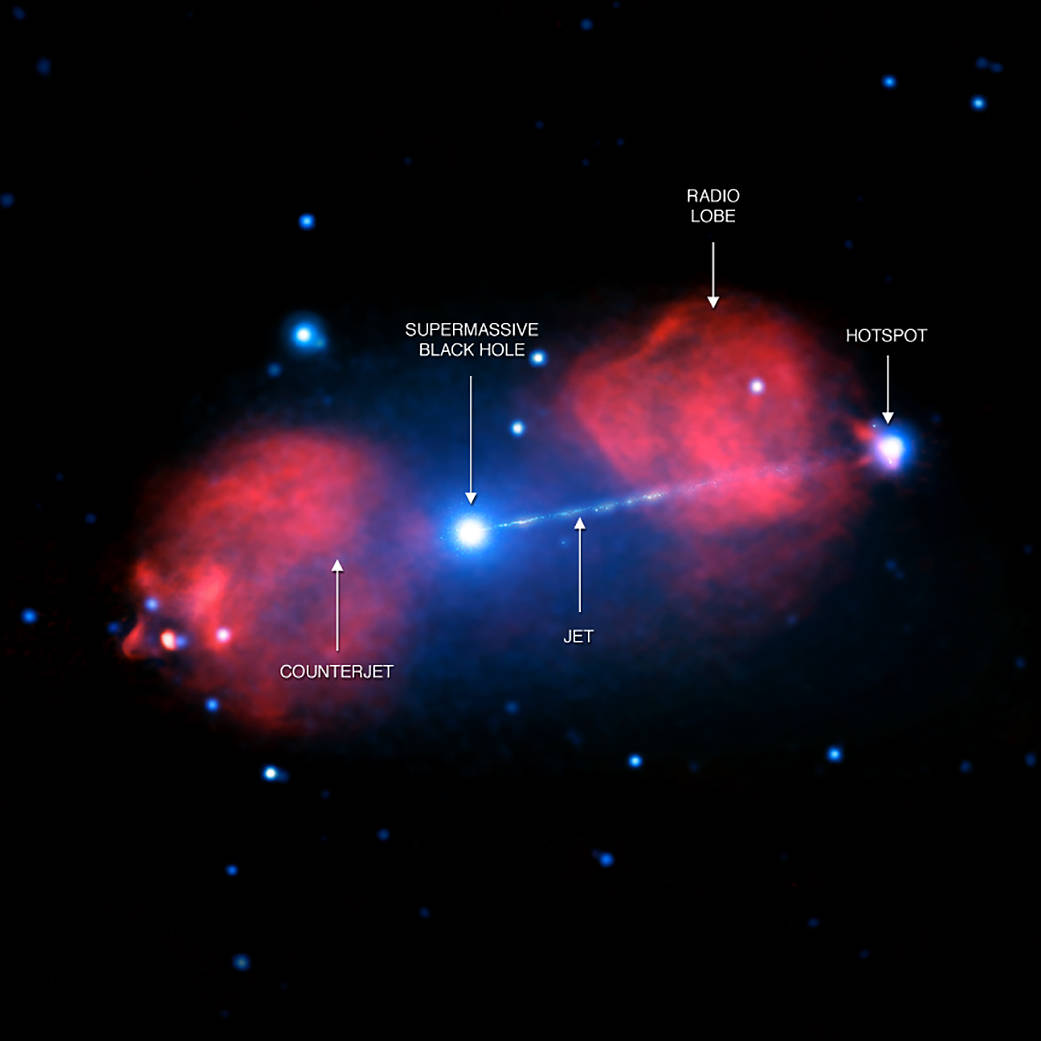
An annotated version of the X-ray/radio composite image of Pictor A, showing the counterjet, the Hot Spot, and many other fascinating features. Powered by an active galaxy, this relativistic jet emits an enormous amount of energy, but over long (~million year) timescales, rather than all at once.
Credit: X-ray: NASA/CXC/Univ. of Hertfordshire/M. Hardcastle et al.; Radio: CSIRO/ATNF/ATCA
Our Milky Way was recently active, with Sagittarius A* still emitting occasional flares.
On September 14, 2013, astronomers caught the largest X-ray flare ever detected from the supermassive black hole at the center of the Milky Way, known as Sagittarius A*. In X-rays, no event horizon is visible at these resolutions; the “light” is purely disk-like. However, we can be certain that only matter remaining outside the event horizon generates light; matter passing within it gets added to the black hole’s mass, inevitably infalling into the black hole’s central singularity. Many types of transients are now known to exist across many different wavelengths of light.
Large “Fermi bubbles” provide evidence supporting recent outflows.
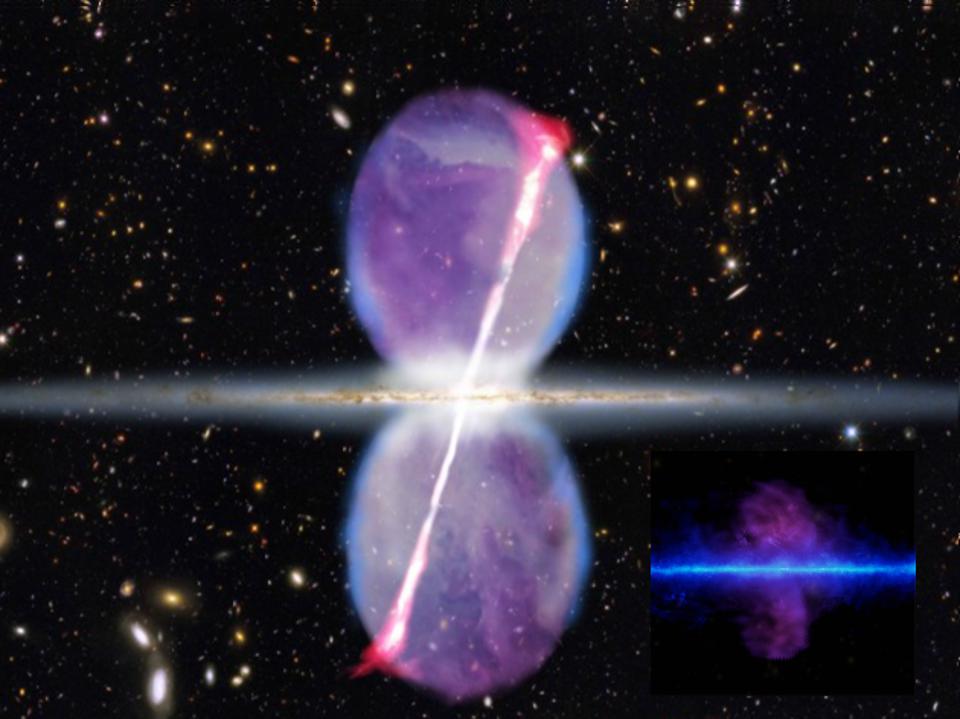
In the main image, our galaxy’s antimatter jets are illustrated, blowing ‘Fermi bubbles’ in the halo of gas surrounding our galaxy. In the small, inset image, actual Fermi data shows the gamma-ray emissions resulting from this process. These “bubbles” arise from the energy produced by electron-positron annihilation: an example of matter and antimatter interacting and being converted into pure energy via E = mc². We are certain that no antimatter signature in our galaxy arises from either antimatter stars or large clumps of antimatter.
Credit: David A. Aguilar (main); NASA/GSFC/Fermi (inset)
This image, made of composite X-ray (Chandra) and radio (MeerKAT) data, shows evidence for an exhaust vent attached to a previously-identified galactic chimney, highlighting how energy and gas is transported away from the galactic center over time.
Credit: X-ray: NASA/CXC/Univ. of Chicago/S.C. Mackey et al.; Radio: NRF/SARAO/MeerKAT; Image Processing: NASA/CXC/SAO/N. Wolk
Using data from the MeerKAT telescope, a team of Northwestern University researchers discovered that filaments emerging from the galactic center of our Milky Way are heavily collimated on degree-scales, teaching us about the geometry of collimated outflows from around our supermassive black hole: Sagittarius A*.
Credit: F. Yusef-Zadeh et al., Astrophysical Journal Letters, 2023
This timelapse series of radio images from the VLBA of the emissions around galaxy 1ES 1927+654 shows a significant brightening and “moving apart” of the radio features. The data indicates that these jets are outflowing at ~30% the speed of light.
Visible filaments often emerge from supermassive black holes.
This view of galaxy NGC 1275, at the core of the Perseus cluster of galaxies, is one of the closest modern giant ellipticals known, located merely 230 million light-years away. Although the center of the galaxy is gas-poor, the circumgalactic medium surrounding it still possesses gas. Highlighted with Hubble imagery here, the red filaments are composed of cool gas being suspended by a magnetic field, with ~50,000,000+ K hot gas located internally. At least some of these jet-like features are likely related to the galaxy’s central supermassive black hole.
Credit: NASA, ESA, and the Hubble Heritage (STScI/AURA)-ESA/Hubble Collaboration
This illustration shows how black hole jets can be as large as the scale of the cosmic web itself, with Porphyrion, as illustrated here, setting a new cosmic record with its bipolar jets spanning 23-24 million light-years across.
Credit: Erik Wernquist/Dylan Nelson (IllustrisTNG collaboration)/Martijn Oei; Design: Samuel Hermans
Mostly Mute Monday tells an astronomical story in images, visuals, and no more than 200 words.