


Our Universe, to the best of our knowledge, doesn’t make sense in an extremely fundamental way. On the one hand, we have quantum physics, which does an exquisite job of describing the fundamental particles and the electromagnetic and nuclear forces and interactions that take place between them. On the other hand, we have general relativity, which — with equal success — describes the way that matter and energy move through space and time, as well as how space and time themselves evolve in the presence of matter and energy. These two separate ways of viewing the Universe, successful though they may be, simply don’t make sense when you put them together: they’re fundamentally incompatible.
When it comes to gravity, we have to treat the Universe classically: all forms of matter-and-energy have well-defined positions and motions through space and time, without any hint of uncertainty. But quantum mechanically, position and momentum can’t be simultaneously defined for any quantum of matter or energy; that’s one clear illustration of an inherent contradiction between these two frameworks for viewing the Universe.
For over 100 years now, scientists have hoped to find a “theory of everything” that not only resolves this contradiction, but that explains all the forces, interactions, and particles of the Universe with one single, unifying equation. Despite a myriad of attempts at a theory of everything, not a single one has brought us any closer to understanding or explaining our actual reality. In fact, all of these extensions to currently known physics, wherever their predictions have differed from the current consensus picture and have been tested by observation or experiment, have been ruled out. It’s possible that not only are they all wrong, but that the entire idea of a “theory of everything” is misguided.

When general relativity came along in 1915, the quantum revolution had already begun. Light, described as an electromagnetic wave by Maxwell in the 19th century, had been shown to display particle-like properties as well through the photoelectric effect. Electrons within atoms could only occupy a series of discrete energy levels, demonstrating that nature was often discrete, not always continuous. And scattering experiments showed that, at an elementary level, reality was described by individual quanta, possessing specific properties common to all members of their species.
Nevertheless, Einstein’s general relativity — which itself had previously unified special relativity (motion at all speeds, even close to the speed of light) with gravitation — wove together a four-dimensional fabric of spacetime in order to describe gravity. Building upon it, mathematician Theodor Kaluza, in 1919 took a brilliant but speculative leap: into the fifth dimension.
By adding a fifth spatial dimension to Einstein’s field equations, he could incorporate the classical electromagnetism of Maxwell into the same framework, with the scalar electric potential and the three-vector magnetic potential included as well. This was the first attempt at building a theory of everything: a theory that could describe all the interactions that were happening in the Universe with a single, unifying equation.

But there were three problems of Kaluza’s theory that posed difficulties.
- There was absolutely no dependence of anything that we observed in our four-dimensional spacetime on the fifth dimension itself; that “extra dimension” to reality must somehow disappear from every single one of the equations that impacted physically observable reality.
- The Universe isn’t simply made of classical (Maxwell’s) electromagnetism and classical (Einstein’s) gravity, but exhibited phenomena that couldn’t be explained by either, such as radioactive decay and quantization of energy: what would serve as the motivational foundations for the development of quantum physics.
- And Kaluza’s theory also included an “extra” field that wasn’t previously found in nature: the dilaton, which is a field that played no role in either Maxwell’s electromagnetism or Einstein’s gravity. Somehow, that field has to either disappear (or decouple) from all known physical theories, as well.
When people refer to Einstein’s pursuit of a unified theory, they often wonder, “Why did everyone abandon what Einstein was working on after his death?” These problems shed light onto the reasons why: Einstein never updated his pursuit of a unified theory to include our knowledge of the quantum Universe. This means that his ideas for unification, a supposed “theory of everything,” both didn’t explain the full suite of what we already knew while simultaneously predicting “extra” things that aren’t there. In physics, that almost always signifies a dead-end.
As soon as we learned that it wasn’t just particles that had quantum properties, but quantum fields too — i.e., the invisible interactions that permeated even empty space were quantum in nature — it became obvious that any purely classical attempt to build a theory of everything would necessarily omit an obvious necessity: the full scope of the quantum realm.

However, another potential path to a theory of everything was beginning to unveil itself during the middle of the 20th century: the notion of symmetries (and symmetry-breaking) in quantum field theories. Here in our modern, low-energy Universe, there are many important ways that nature is not symmetric.
- Neutrinos are always left-handed and antineutrinos are always right-handed, and never the other way around.
- We inhabit a Universe that’s almost exclusively made of matter and not antimatter, but where all reactions we know how to trigger only create or destroy matter and antimatter in equal (and opposite) amounts.
- And some interactions — most notably, particles interacting through the weak force — exhibit asymmetries when particles are replaced with antiparticles, when reflected in a mirror, or when their clocks are run backward instead of forward.
However, at least one symmetry that’s badly broken today, the electroweak symmetry, was restored at earlier times and higher energies. The theory of electroweak unification was vindicated with the subsequent discovery of the massive W-and-Z bosons, and later, the entire mechanism was validated with the discovery of the Higgs boson.
It makes one wonder: if the electromagnetic and weak forces unify under some early, high-energy conditions, could the strong nuclear force join them at an even higher scale? And at some energy scale even above that, could gravity join in the unification story as well?

This wasn’t some obscure idea that took a brilliant insight to arrive at, but rather a path that a great number of mainstream physicists followed: the path of what’s generally known as grand unification. Each of the three known quantum forces could be described by a Lie group from the mathematics of group theory.
- The SU(3) group describes the strong nuclear force, which holds protons and neutrons together.
- The SU(2) group describes the weak nuclear force, responsible for radioactive decays and the flavor changes of all quarks and leptons.
- And the U(1) group describes the electromagnetic force, responsible for electric charge, currents, and light.
The full Standard Model, then, can be expressed as SU(3) ⊗ SU(2) ⊗ U(1), but not in the way you might think. You might think, seeing this, that SU(3) = “the strong force,” SU(2) = “the weak force,” and U(1) = “the electromagnetic force,” but this is not quite true. The problem with this interpretation is that we know that the electromagnetic and the weak components of the Standard Model overlap, and cannot be separated out cleanly.
Therefore, even though they could have been arranged this way, we can conclude that the U(1) part isn’t purely electromagnetic, and the SU(2) part isn’t purely weak; there has to be mixing going on between them. It’s more accurate to say that SU(3) = “the strong force” and that SU(2) ⊗ U(1) = “the electroweak force,” and demonstrating this behavior helps explain why the discovery of the W-and-Z bosons, plus the Higgs boson, were so important to our fundamental understanding of the Universe.

It seems like an easy extension, logically, that if these groups, combined, describe the Standard Model and the forces/interactions that exist in our low-energy Universe, perhaps there’s some larger, grander group that not only contains them all, but that under some set of high-energy conditions, represents a unified “strong-electroweak” force. This was the original idea behind Grand Unified Theories, which would either:
- restore a left-right symmetry to nature, rather than the chiral asymmetry found in the Standard Model,
- or, much like Kaluza’s original attempt at unification, necessitate the existence of new particles: such as the superheavy X-and-Y bosons, which couple to both quarks and leptons and demand that the proton be a fundamentally unstable particle,
- or demand both: a left-right symmetry and these superheavy particles, plus perhaps even more.
However, no matter what experiments we’ve performed under any arbitrary conditions — including the highest-energy ones seen in LHC data and from cosmic ray interactions — the Universe still remains fundamentally asymmetric between left-handed and right-handed particles, these new particles are nowhere to be found, and the proton never decays, with its lifetime having been established to be upward of 10³⁴ years. That last limit, already is a factor of approximately 10,000 more stringent (longer) than is permitted by the Georgi-Glashow SU(5) unification scenario.
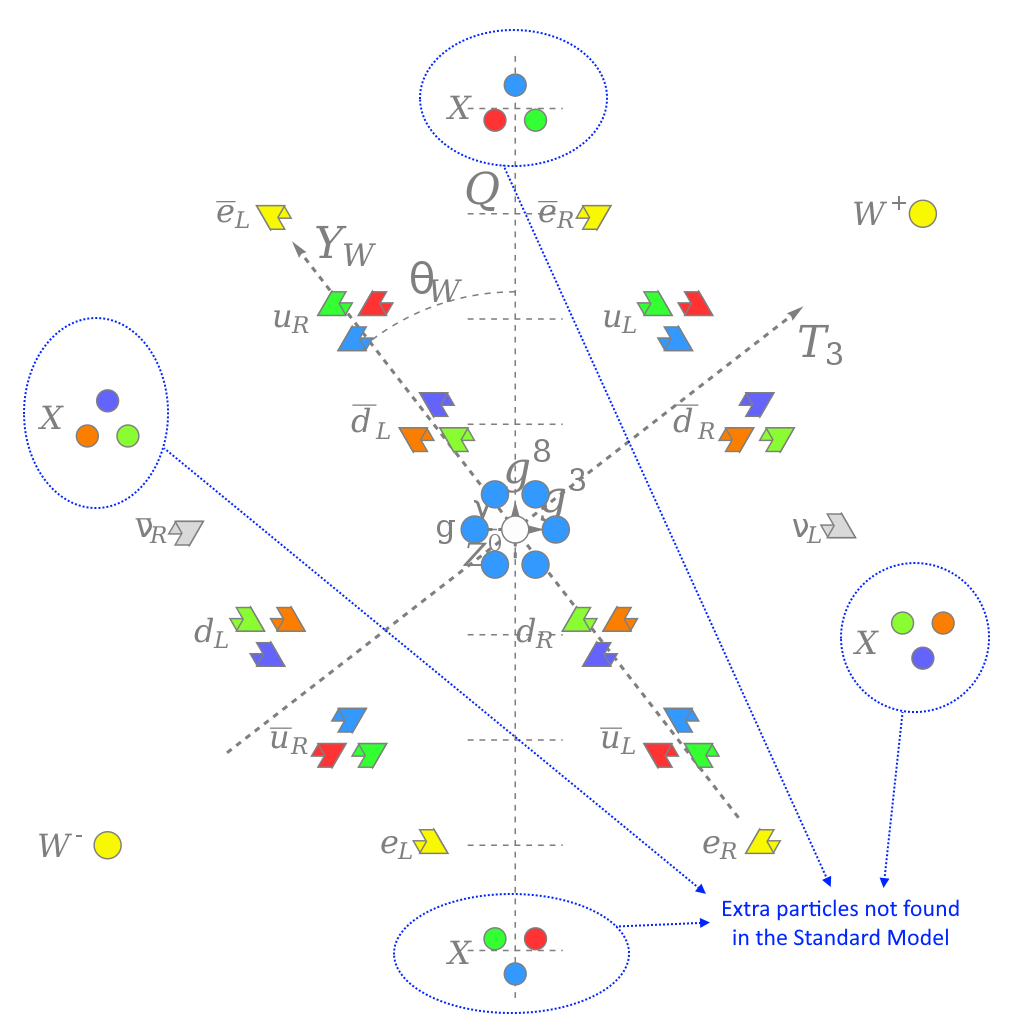
This tells us that the simplest ideas for grand unification represent a suggestive line of thought, but when you perform the calculations to derive observable predictions, the new particles and phenomena that ought to be there simply don’t materialize in our Universe. Either something is suppressing them and they do exist at some level, or these particles and phenomena simply aren’t a part of our reality.
Another approach toward unification that was tried was to examine the three quantum forces within our Universe, and to take a specific look at the strength of their interactions. While the strong nuclear, weak nuclear, and electromagnetic forces all have different interaction strengths today, at everyday (low) energies, it’s been known for a long time that the strengths of these forces change (or scale) as we perform experiments that probe nature at higher and higher energies.
At higher energies, such as those achieved in particle accelerator-colliders or in the early stages of the hot Big Bang, the strong nuclear force weakens compared to its modern value, while the electromagnetic and weak forces both get stronger, with the electromagnetic force getting stronger more rapidly than the weak force as we go to successively higher energies. If we only include the particles of the Standard Model, the interaction strength of these forces almost meets at a single point (up at around 10¹⁵ GeV of energy), but not quite; they miss by just a little bit. However, if we add new particles into the theory — which should arise in a number of extensions to the Standard Model, such as supersymmetry — then the coupling constants change differently, and might even meet, overlapping at some very high energy.

But this is a challenging game to play, and it’s easy to see why. The more you want things to “come together” in some way at high energies, the more new things you need to introduce into your theory. But the more new things you introduce into your theory, such as:
- new particles,
- new forces,
- new interactions,
- or new dimensions,
the more and more difficult it becomes to hide the effects of their presence, even in our modern, low-energy Universe.
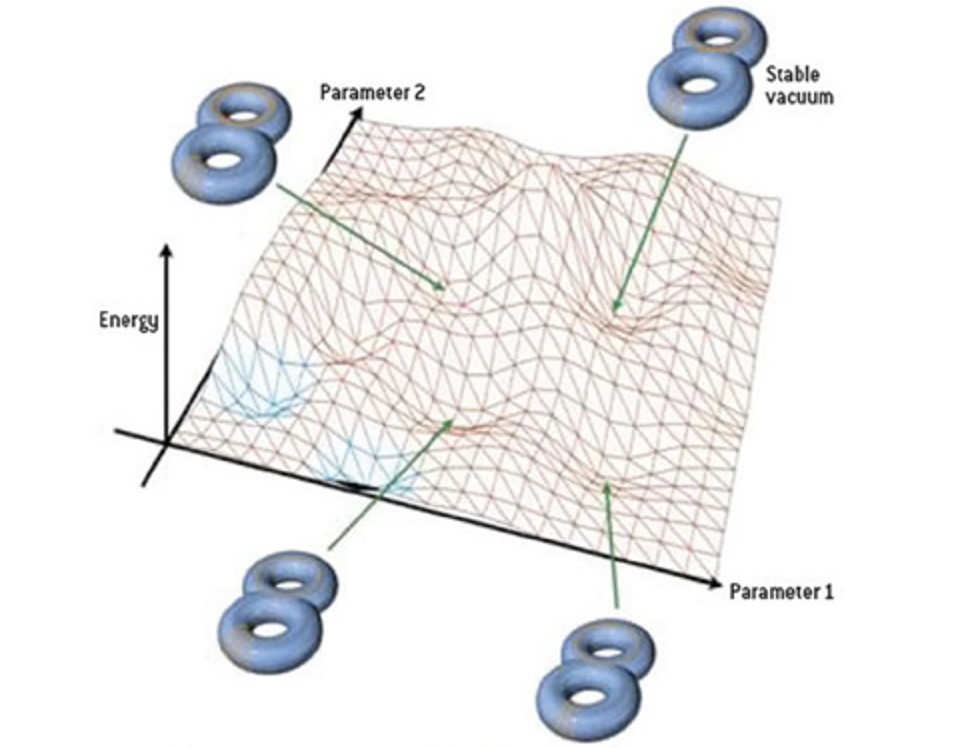
For example, if you favor string theory, a “small” unification group like SU(5) or SO(10) will be woefully inadequate. You have to go up to a much larger group, the exceptional group E6, to get the spectrum of particles and fields that are predicted to exist in our four-dimensional Universe today. But this enormous group in four dimensions isn’t even the entire story; it’s just what remains after an initially 10-dimensional spacetime, covered by a still much larger Lie group — where the only two known groups with the right properties are SO(32) and E8 ⊗ E8 — has broken down to the four-dimensional reality we know that we inhabit today.

It’s true that string theory does offer a hope for a single theory of everything in one sense: these enormous, 10-dimensional superstructures that describes the full theory, mathematically, do in fact contain all of general relativity and all of the Standard Model within them.
That’s good!
But they also contain much, much more than that. General relativity is a tensor theory of gravity in four dimensions: matter and energy deform the fabric of spacetime (with three space dimensions and one time dimension) in a very particular way, and then move through that distorted spacetime. In particular, there are no “scalar” or “vector” components to Einstein’s general relativity, and yet, what’s contained within string theory is a scalar-tensor theory of gravity: initially in ten dimensions, not the four we inhabit today. Somehow, our Universe must have arisen when exactly six (no more, no less) of those dimensions, as well as the “scalar” part of the theory, all disappeared, and now play no role in how gravity works in our Universe.
In addition, string theory also contains the Standard Model with its six quarks and antiquarks, six leptons and antileptons, and the bosons: gluons, W-and-Z bosons, the photon, and the Higgs boson. But even after an initially 10-dimensional string theory “breaks” to give us the 4-dimensional universe we inhabit, that enormous E6 group predicts the existence of several hundred new, undiscovered, fundamental particles. Because we see that evidence against the existence (or, at least, the relevance) of such particles in a variety of collider-detector experiments, they must all somehow be “hidden away” from us in our present Universe. It’s for this reason that searching for a “theory of everything” is a very difficult game to play: almost any modification you can make to our current theories is already highly constrained by existing data.
Most of the other alternatives touting to be “theories of everything,” including:
- Erik Verlinde’s entropic gravity,
- Stephen Wolfram’s “new kind of science,”
- or Eric Weinstein’s geometric unity,
don’t merely suffer from these problems of “predicting things that aren’t there,” they struggle mightily to even recover and reproduce what’s already known and established by present-day science: the plain old Standard Model with general relativity. Removing the “extra parts” that don’t manifest in our Universe is an entirely separate challenge, one that’s usually accompanied by a lot of hand-waving and the muttering of ill-defined terms without a clear mechanism, like compactification. Do these purported theories of everything line up with our current picture of reality? Only if you deliberately blur the current picture of reality — akin to putting vaseline on the camera lens — to look at it from a biased point of view. If you just look at the facts, these theories predict things that aren’t there, and struggle to recover the Universe that we’ve established does match reality.
Searching for a “theory of everything” isn’t necessarily wrong or impossible, but it’s certainly an ambitious challenge, one that theorists haven’t sufficiently risen to at present. No currently entertained theory has cleared the hurdles required to become an established part of our consensus scientific picture, despite the hype, the promise, and the hope of such an achievement. Remember, in any scientific endeavor, if you want to replace the currently prevailing scientific theory in any realm, you must meet all three of these critical steps:
- Reproduce all of the successes and victories of the present theory.
- Explain certain puzzles that the present theory cannot explain.
- And make new predictions that differ from the present theory, that we can then go out and test.
To date, even “step 1” can only be claimed if certain new puzzles that rear their heads in purported theories of everything are swept under the rug, and almost all such theories either fail to make a novel prediction or are already dead-in-the-water because what they predicted hasn’t panned out. (Looking at you, flavor changing neutral currents.) It’s true that theorists are free to spend their lives on whatever endeavors they choose, but if you’re questing for a theory of everything, beware: the goal that you seek may not even be part of the true underlying description of nature.
This article was first published in April of 2023. It was updated in April of 2026.

The Energy Transition


