


Here on Earth, there are enormous variations in the densities of what we commonly encounter. Solid, dense metals, like gold or tungsten, have very high densities. If you had a cube that was one meter (3 feet and 3.39 inches) on a side — a cubic meter — made of gold, it would weigh approximately 19 metric tonnes: over 42,000 pounds. If that cube were instead made of water, it would weigh only 1 metric tonne, or 2205 pounds. Make that same cube out of air at room temperature and at sea level, and it weighs in at just around 1.2 kilograms, or 2.6 pounds. And even though it’s a struggle to create a vacuum on Earth, a volume of space as devoid of particles as possible, we’ve created apparatuses that reduce densities to less than one-trillionth of the air density normally found on Earth.
But we often talk about outer space as being the ultimate in emptiness. The densities found in the Universe can be extreme when compared to anything found on our planet, even with all the advances we’ve made in science and technology. How does what we find in the Universe compare, density-wise, to what we’re familiar with here on Earth? That’s what Paul Kyzivat wants to know, writing in to inquire:
“How do the densities of interstellar gas clouds relate to densities people experience? Would it be denser than space in low Earth orbit? What would the density, in human terms, be in a protoplanetary disk?”
There’s a whole lot out there in the abyss of deep space, with interplanetary, interstellar, and intergalactic spaces all boasting vastly different densities from not only what we find on Earth, but from one another as well.

In laboratory settings, we often create vacuums for a variety of reasons. At NASA, for instance, vacuum chambers exist to test spaceflight hardware, ensuring that it will be resilient and remain functional in the extreme, low-pressure environments typically found in space. Extreme temperatures, often down to as low as -260 °C (-436 °F), accompany these low pressures, which can reach down to below one-billionth of Earth’s normal atmospheric pressure. In terms of the unit known as a Pascal (where 1 Pa = 1 N/m²), Earth’s atmospheric pressure is approximately 101,000 Pa, whereas Chamber A at NASA’s Johnson Space Center (where the JWST was tested, shown above), can reach pressures as low as 0.0001 Pa, even approaching 0.00001 Pa at its absolute extremes.
That’s a remarkable vacuum, but there are two other vacuum systems that stand above all others, here on Earth, in terms of how pristine it is, or how few particles remain inside of it. They are:
- the ultra-high vacuums created inside LIGO’s extreme vacuum chamber, which encompasses 10,000 cubic meters, took over 40 days of constant pumping to evacuate, and reached pressures as low as 0.00000013 Pa (one-trillionth of Earth’s standard atmospheric pressure),
- and at the Large Hadron Collider at CERN, kept at temperatures between 1.9 and 20 K, where the vacuum reaches an astounding 0.1-trillionth of Earth’s atmospheric pressures at the extremes: 10 billionths of one Pascal.
This represents a remarkably low density: the lowest ever achieved on Earth under any conditions, laboratory or natural.

However, you shouldn’t be fooled by those tiny numbers: even under these extreme vacuum conditions, that still equates to a significant number of particles inside a given volume of space. Earth’s atmospheric pressure under standard conditions yields about 40-41 moles per cubic meter of volume, where a mole is one Avogadro’s number (6 × 10²³) worth of particles. This means that even inside the most rarified part of the Large Hadron Collider’s vacuum, the density of particles is still around 2.4 trillion (2.4 × 10¹²) atoms per cubic meter of space. That’s extremely low-density compared to what we conventionally experience, but there are certainly going to be regions of space that are even less dense.
Remember: space is mostly empty, and the distances separating objects is vast. The greatest densities of particles are found where matter has gathered together in the most significant ways, such as in or around planets, stars, and other dense, massive objects.
For example, we normally think of the Moon as an airless world, devoid of an atmosphere entirely. This is an excellent approximation in most circumstances, so long as we restrict ourselves to comparing the density of the lunar “atmosphere” to atmospheres found on Earth or elsewhere in the Solar System. However, largely induced by interactions with solar radiation and the solar wind (although the bombardment of the surface by micrometeorites and the radioactive decay of elements interior to the Moon also contribute), elements found in lunar dust often levitate, giving the Moon a very thin atmosphere of around 0.3 nanopascals, composed primarily of:
- argon,
- helium,
- and neon,
with trace amounts of sodium, potassium, and hydrogen as well. In terms of density, the Moon’s atmosphere has approximately 80 billion particles per cubic meter.

Importantly, this is a lower density than is found anywhere on Earth, even in our most pristine vacuums. However, it’s also a relatively large density compared to the other “sparse” places found in the Universe. If we look to the space between stars — known as the interstellar medium — we will sometimes come across clouds of gas. Many of these clouds are hot, sparse, and fast-moving, which makes them poor candidates for forming new stars anytime in the near future. However, the clouds that are dense, cold, and moving slowly are often prime candidates to first contract, and then to fragment and collapse, leading to new stars.
The sparse clouds might only have densities of 1-to-100 million particles per cubic meter, but denser ones can have a billion to a trillion particles per cubic meter: comparable to the density of the lunar atmosphere. These are not at all densities that we experience on Earth; they’re far sparser, even compared to the most pristine vacua that we can create here on our planet. The environments where new stars form might have large densities compared to the overall density of the Universe, but they are remarkably low-density compared to anything on our planet.

For protoplanetary disks, these represent much denser, later-stage environments than the gas clouds that gave rise to both them and the stars they surround. Imagine taking a huge cloud of gas, and compressing much of that material down into just a few clumps that were much smaller in physical size. Sure, those clumps will heat up and begin emitting radiation as they shrink in size: gravitational contraction transforms potential energy into kinetic energy, and the kinetic energy of the particles inside leads to the material radiating at a particular temperature.
But not all of that material is hydrogen and helium; by this point in cosmic history, about 1-2% of it, particularly in our own galaxy, is made up of heavier elements: oxygen, carbon, nitrogen, silicon, sulfur, iron, and many other rocky and metallic materials. Those materials are the heaviest and densest ones, and so they tend to sink: toward the mid-planes of protoplanetary disks with greater densities close to the star/protostar that they surround. In the densest parts of protoplanetary disks, densities can reach up to 100 trillion particles per cubic meter: comparable to the most extreme vacuum we can create on Earth.
This shouldn’t be a surprise, as these environments give rise to planets, moons, and other solid bodies routinely found in stellar systems. As gravitational effects begin to dominate, it’s the most massive, densest clumps that attract the most matter into them, and hence become the most likely bodies to survive the violence of their infancies.
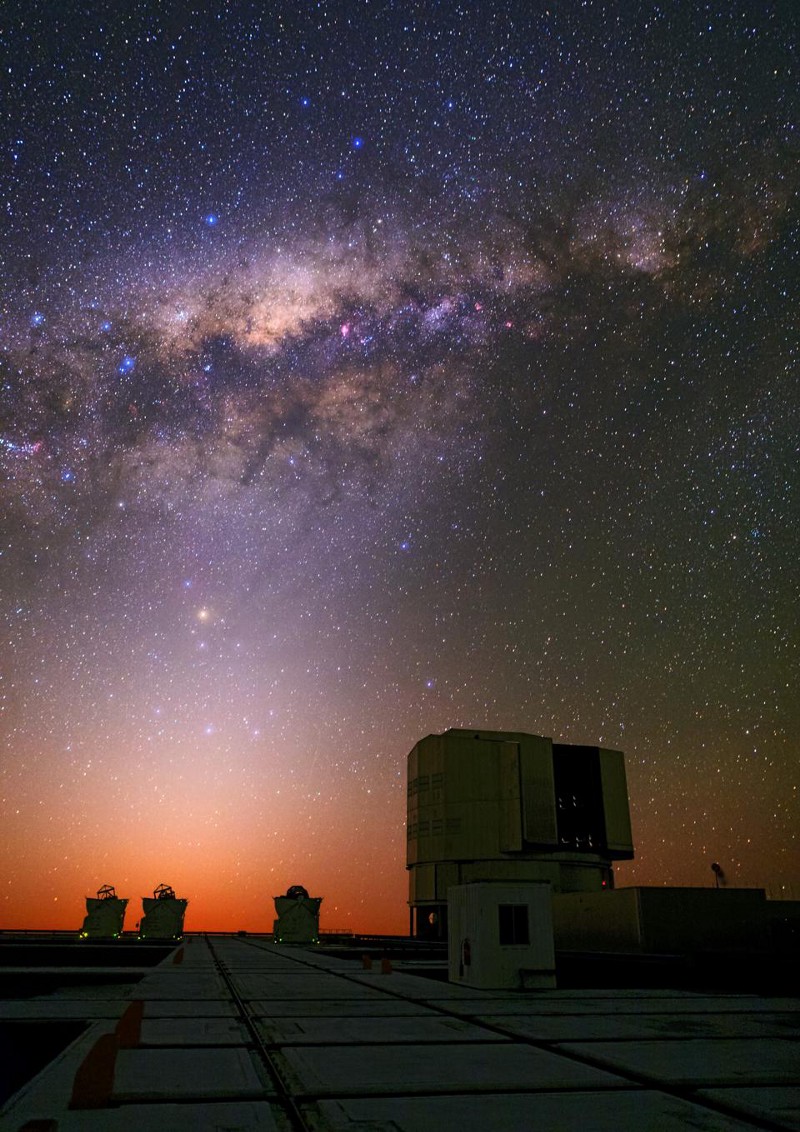
However, if you go into the depths of space, away from any large masses or collections of material, densities go in the opposite direction: they drop precipitously. Here in our own solar system, we’ve got planets, moons, asteroids, centaurs (small objects between the asteroid and Kuiper belts), Kuiper belt objects, and Oort cloud objects — along with our Sun — as the dense, massive objects that are clumped together. Our protoplanetary disk has long since evaporated, as has any trace of a circumstellar debris disk. There are only a small number of tiny particles that remain within the solar system: some emitted by the Sun, some entering from interstellar space, and some persisting as a cloud of interplanetary dust that’s observable as the reflected source of our zodiacal light.
There is very, very little of this interplanetary dust, particularly in comparison to the environments we were discussing just recently: interstellar gas clouds and protoplanetary disks. However, for every cubic meter of interplanetary space, there are still between 5 and 40 million particles: mostly atoms, mostly heavier elements, but with some lighter elements and ions mixed in among them. These densities are smaller than anything we’ve considered so far, lower than in even the sparse, fast-moving, hot interstellar gas clouds. But the interplanetary environment is still within our Solar System, and hence is still denser, on average, than what we find when we go all the way to interstellar space: the space outside of, rather than interior to, any stellar system.

In interstellar space — far away from any sites of star-formation or planet-formation, and outside of any interstellar gas clouds — the densities now really begin to drop. If you were to exit the solar system the way that Voyager 1 and Voyager 2 did, you’d find yourself beyond the Sun’s sphere of influence and in true interstellar space. There would be occasional dust grains, but they’re far less abundant than within our solar system, and represent only about 1% of the matter in interstellar space. Instead, the interstellar medium is dominated by gas, and mostly hydrogen gas at that, but in the warmer, more diffuse regions of space, that gas becomes ionized, rendering it into a plasma.
Even outside of molecular clouds, the denser neutral regions of the interstellar medium have approximately one million particles per cubic meter in it. But in the sparser regions, which tend to be:
- hotter and more dilute,
- as well as in the galactic halo rather than in the plane,
- and more toward the outskirts of the galaxy than toward the galactic center,
there can be as few as a thousand particles per cubic meter or even only a few hundred particles per cubic meter. The interstellar medium has lower densities than anything achieved in any of the aforementioned places we’ve discussed so far: interplanetary space, above the surfaces of “airless” worlds, in protoplanetary systems, or in gas clouds. But matter has already clumped together into these galaxies, where it was accreted, long ago, from the regions that aren’t rich in galaxies today: the depths of intergalactic space.
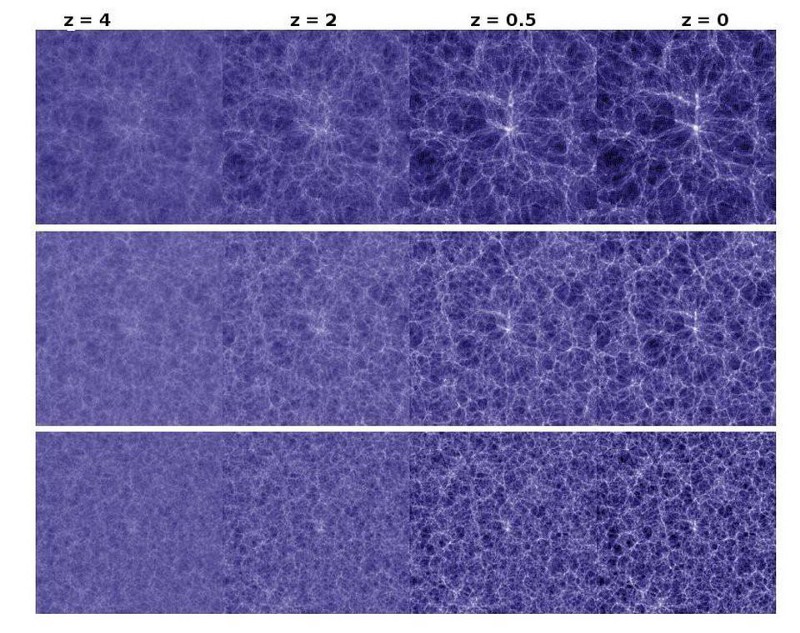
Intergalactic space, in our modern Universe, represents the regions that have done exactly this: that have given up their matter, over billions of years, to the denser regions that surround them. They represent regions of merely average or even below-average cosmic densities. Far away from any galaxies, they represent the losers in the great cosmic struggle between expansion and gravitation. Whereas star clusters, galaxies, galaxy clusters, and the filaments of the great cosmic web represent the winners — where initially overdense regions grew by attracting additional matter from their surroundings — the regions that gave up their matter to enable the formation of those objects have the lowest densities in the Universe.
The easiest way to figure out the average density of intergalactic space, because it really doesn’t leave observable signals imprinted on the light that travels through it, is to go all the way back to the earliest signals we have from the Big Bang:
- the light from the cosmic microwave background, which tells us the ratio of dark matter to normal matter is about five-to-one, and that allow us to measure the photon density in the Universe,
- and the abundances of the light elements, which tell us the baryon-to-photon ratio, or how many protons-and-neutrons, combined, exist for every photon created in the Big Bang.
Those numbers have extremely small errors on them today: the photon number density from the Big Bang is 411 per cubic centimeter, while the baryon-to-photon ratio is about 6.1 × 10⁻¹⁰, or that there are about 1.6 billion photons for every one baryon.
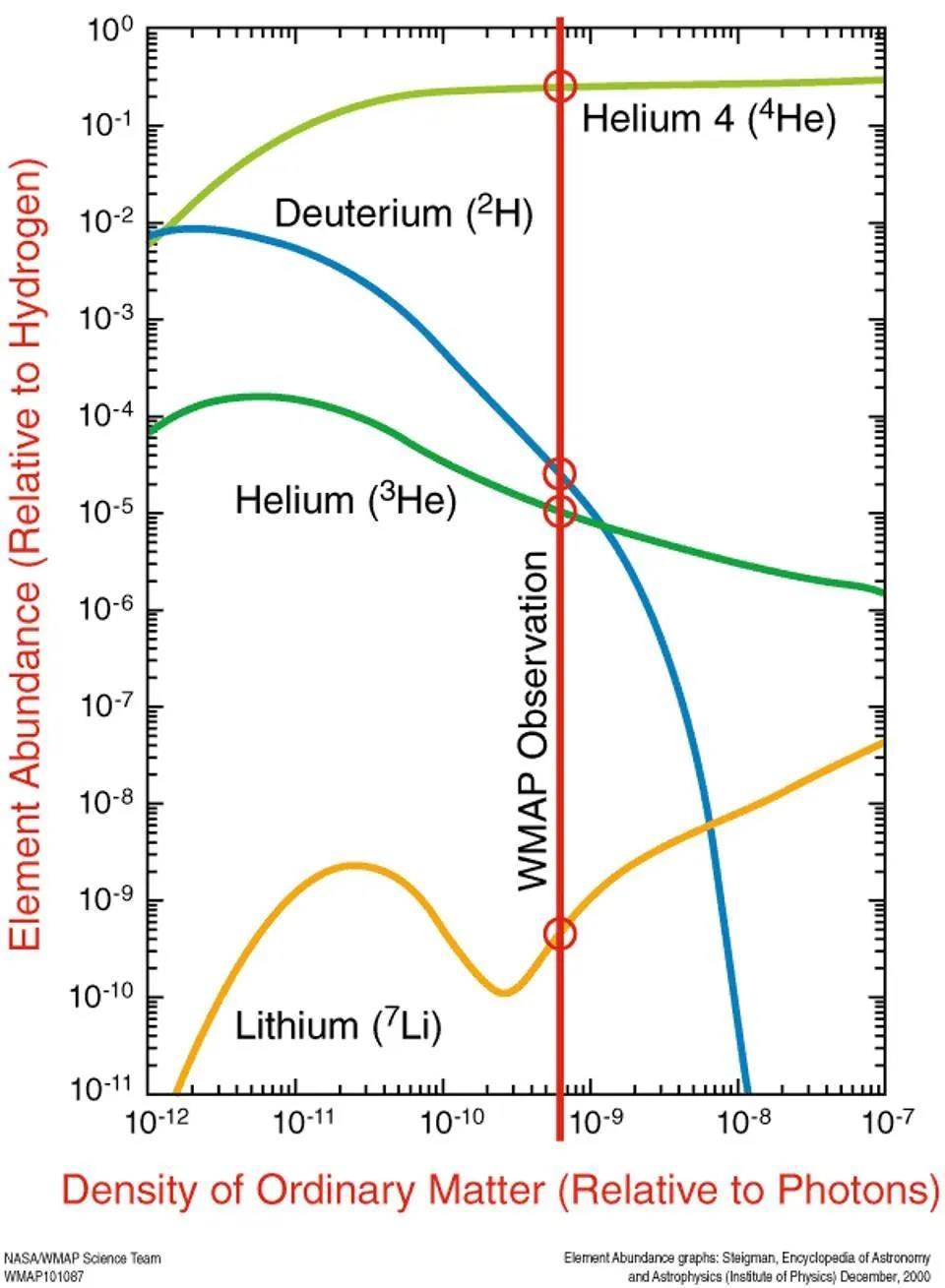
That translates, with a little math, into a density of about 0.25 hydrogen atoms per cubic meter. That’s how sparse things are, on average, in our Universe. There’s about five times as much dark matter, but since dark matter doesn’t appear to interact with light or normal matter, it only appears gravitationally.
But remember: we don’t just have overdense regions like galaxies and their surrounding environments, we also have underdense regions in the form of cosmic voids. While if you measure a cosmic void by the number of galaxies found within it, you might estimate that these voids are very empty regions, only containing about 10-20% of the number of galaxies found outside of them, tests using starlight absorption or weak gravitational lensing that are sensitive to even very low-density collections of neutral matter reveal that there is still normal matter present in substantial amounts in these voids.
Even in the most extreme, modern cosmic voids, approximately 50% of the “average” matter density is still present, indicating that the most extreme earlier estimates, which insisted that only 10-20% of the normal matter density remained, were far too severe. It looks like even in the deepest depths of intergalactic space, with the lowest matter densities of all, there are still approximately 0.1 protons (and 0.1 electrons) present per cubic meter of volume. If we want to go lower still, we’ll have to wait for the Universe to expand: increasing its volume while the total number of particles remains constant.

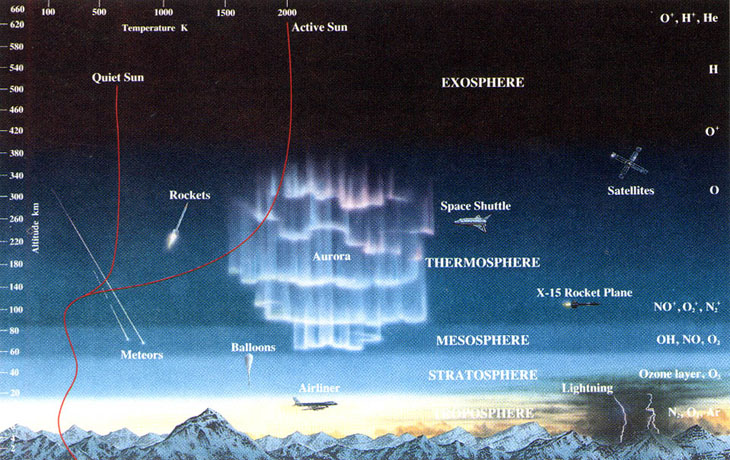
You might wonder how all of this compares with what we typically consider “outer space” to be, which is usually synonymous with low-Earth orbit: just a few hundred kilometers up. Even though the densities up there are much smaller than they are, say, lower down on our planet, or closer to the surface, they’re still enormous compared to all of the more pristine considerations we’ve made thus far. In addition to the uppermost part of our atmosphere (the exosphere) that we must contend with, which corresponds to a density of around a few hundred trillion particles per cubic meter, we’d also experience:
- naturally occurring micrometeoroids, which are particles ranging from micron-to-millimeter sizes, with many billions of them in the vicinity of low-Earth orbit,
- small pieces of human-made space debris, with over 130 million pieces in low-Earth orbit of ~centimeter size or below,
- approximately 1.1 million pieces of medium-size human-made space debris (greater than 1 cm in size) in low-Earth orbit,
- tens of thousands of large (bigger than 10 cm, or 4 inches, in size) pieces of human-made space debris,
- and nearly 20,000 satellites, both active and inactive, in low-Earth orbit.
In other words, what we commonly call “the vacuum of space” is only a good vacuum in comparison to the extremely dense conditions we find here on Earth: in conventional solids, liquids, and gases. Gas clouds and the Moon’s atmosphere are comparable to the best vacuum systems we engineer and operate here on Earth, but they still have billions or even trillions of particles inside every cubic meter of volume. Interplanetary and interstellar space are even sparser, but still have millions of particles per cubic meter, on average, with the hottest, sparsest regions of the interstellar medium still having hundreds-to-thousands of particles per cubic meter.
Only in the deep depths of intergalactic space do we reach the average cosmic density: of 1 particle per cubic meter (or, in great voids, a fraction of a particle per cubic meter). Only in these environments do we come close to the ideal version of what “empty space” truly would be. From our position within the Milky Way, it would take a journey of millions of light-years to reach it, showcasing just how far we have to go if we ever hope to measure such an environment directly.
Send in your Ask Ethan questions to startswithabang at gmail dot com!

The Energy Transition


